Did the World End in 2012? Viral Simulation Theory Linked to Mayan Calendar Returns Online
Synopsis
A viral theory claims world ended in 2012 and humanity now lives in a simulation. The idea is linked to Mayan calendar and modern global crises. Scientists and historians say there is no evidence to support the claim, calling it conspiracy theory.
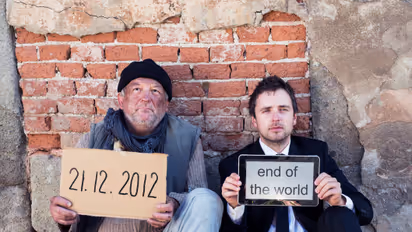
More than a decade after the world was 'supposed' to end, a strange and unsettling theory has once again taken over the internet. The claim suggests that Earth actually ended in 2012 and that humanity has been living inside a simulation ever since.
This belief, often called the '2012 phenomenon', has gained fresh attention on social media platforms like X. Supporters say that the strange events of recent years, from the Covid-19 pandemic to climate disasters and global unrest, are proof that reality is no longer what it seems.
While scientists and historians strongly reject the idea, the theory continues to attract millions of views and heated debate online.
Where the 2012 doomsday idea came from
The roots of the theory go back to the ancient Mayan civilisation and their Long Count calendar. This calendar tracked time in large cycles and was believed to end on December 21, 2012.
In the years leading up to that date, many people believed it marked the end of the world. Some feared massive earthquakes, asteroid impacts, or a complete collapse of human civilisation.
When December 21, 2012 passed without any visible disaster, most experts said the fear was based on a misunderstanding. According to historians, the calendar simply ended one cycle and began another, much like a new year starting on January 1.
Why the theory is popular again now
Despite expert explanations, the idea never fully disappeared. It has now returned with new force, fuelled by the many crises people have faced since 2012. Supporters point to:
- The Covid-19 pandemic
- Extreme climate events
- Wars and political instability
- Economic stress and social division
Together, these events have created a strong feeling that 'something is wrong with the world'.
Believers say we are now living in a 'post-glitch' universe, where reality feels broken and unpredictable.
The simulation explanation
According to the theory, the original Earth was destroyed in 2012. Instead of humanity dying completely, all human consciousness was transferred into another form of reality. Some claim this reality is:
- A computer-run simulation
- A parallel universe
- A spiritual afterlife
- A system run by advanced aliens or a god-like being
Supporters believe life has continued smoothly, but with small errors or 'glitches'.
Mandela Effect and other 'glitches'
One of the strongest arguments made by believers is the Mandela Effect. This is when large groups of people remember events or facts incorrectly but in the same way. Examples often shared online include:
- Misremembered film quotes
- Spelling of famous brand names
- False memories of past events
Supporters say these shared false memories prove that reality has been altered or reset.
What scientists and historians say
Experts across many fields have repeatedly dismissed these claims. Scientists say:
- There is no evidence Earth ended in 2012
- Consciousness transfer is not scientifically possible
- No simulation has ever been detected
NASA scientist David Morrison publicly rejected 2012 doomsday fears, calling them a “big hoax”. He also dismissed claims that a rogue planet would destroy Earth.
Archaeologists also stress that the Mayans never predicted an apocalypse. They say the calendar’s end simply marked the start of a new time cycle.
CERN, the Higgs boson and black hole fears
Some believers link the theory to events at CERN, the European particle physics lab.
In 2012, scientists at CERN discovered the Higgs boson, often called the “God particle”. It was a major scientific breakthrough.
However, conspiracy theorists claim that particle collisions created a tiny black hole that destroyed Earth. Scientists strongly deny this. They say:
- Any microscopic black holes would disappear instantly
- No damage to Earth ever occurred
- The experiments were safe and closely monitored
- Social media reactions fuel the theory
The idea has found strong support on social media. Posts include claims such as:
'The world ended in 2012 and we’re in purgatory'
'Reality feels like a post-credits scene'
'This timeline split after December 2012'
Many users use the theory to explain disasters and strange events.
Elon Musk's simulation comments ]
Tech billionaire Elon Musk has also spoken about the simulation idea in the past. In a podcast interview, Musk said it is possible that reality is a simulation. He compared life to a video game or even an 'alien Netflix series'.
He suggested that humans may exist to keep the simulation interesting, so it is not switched off. While Musk did not claim the world ended in 2012, his remarks have been widely shared by believers.
Why experts urge caution
Psychologists say such theories often rise during times of stress and uncertainty. They can give people a sense of explanation when the world feels chaotic. Experts warn that believing the world already ended can increase fear, anxiety and detachment from reality.
There is no scientific, historical, or physical proof that:
- The world ended in 2012
- A simulation replaced reality
- Consciousness was transferred
Experts agree that the theory is a modern myth shaped by fear, technology, and social media.