Tiny Light Implant Trains the Brain to Read New Signals, Study Shows
Synopsis
A tiny, soft wireless implant developed at Northwestern University sends patterned light directly to the brain, teaching it to interpret entirely new artificial sensations. The technology could transform prosthetics and future neurological therapies.
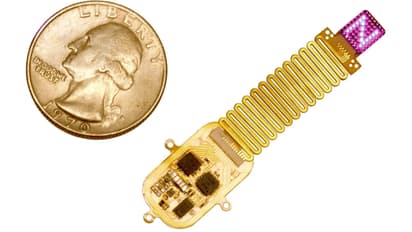
Scientists at Northwestern University have created a tiny wireless implant that sends light-based messages directly into the brain, allowing animals to learn entirely new artificial sensations. The soft, flexible device sits beneath the scalp and projects patterned red light through the skull to activate specific neurons—no wires, probes, or external hardware needed. The study is published in Nature Neuroscience.
Mice Learn to Decode Artificial Sensations
In experiments, mice engineered with light-responsive neurons were trained to recognise specific micro-LED patterns. These signals acted like secret “codes” tapped straight into the cortex. The animals learned to respond correctly to these artificial cues, even without any natural sensory input such as touch, sight, or sound.
The new design contains up to 64 independently controlled micro-LEDs, allowing researchers to mimic the complex neural activity seen during real sensory experiences. This marks a leap forward from the team’s earlier 2021 device, which used only a single LED.
Opening Doors to Future Prosthetics and Therapies
Because the implant can generate diverse neural patterns, it may one day support advanced prosthetic feedback, vision or hearing restoration, stroke recovery, and even non-drug pain therapies. Future versions may expand to larger arrays, deeper-penetrating wavelengths and more sophisticated patterned stimulation.