Jellyfish Sleeps Like Humans? What Do They Tell Us About The Origin of Sleep
Synopsis
Sleep, long considered a privilege of complex brains, may be far more ancient and far more fundamental. New research suggests that sleep emerged at the very dawn of animal evolution, even before brains existed at all.
Sleep, long considered a privilege of complex brains, may be far more ancient and far more fundamental. New research suggests that sleep emerged at the very dawn of animal evolution, even before brains existed at all.
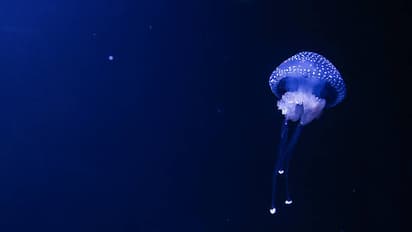
A study examining two brainless marine species—the upside-down jellyfish Cassiopea andromeda and the sea anemone Nematostella vectensis—has found that both organisms display unmistakable sleep-like states. Despite lacking a centralised brain, they regularly enter periods marked by slowed movement, dulled responses to light or touch, and a rebound effect after forced wakefulness. By behavioural standards, this is sleep.
The research, titled "DNA damage modulates sleep drive in basal cnidarians with divergent chronotypes", underscores a striking reality: neither animal has a brain. Instead, both rely on a primitive nerve net spread through soft tissue, with no central command system. Yet they rest. Their motions slow. Their reactions lag. When their rest is interrupted, sleep returns later—longer and deepeR.
In both controlled laboratory conditions and natural environments, the animals repeatedly cycle through phases of reduced activity that meet established definitions of sleep. The findings suggest that the need for rest did not arise with complex nervous systems. It existed long before—shaped differently, but no less necessary.
Light-driven sleep in Cassiopea jellyfish
In Cassiopea, sleep appears to be guided primarily by light. Activity drops sharply at night, rises during daylight hours, and dips briefly again around midday. The jellyfish shows little evidence of a strong internal clock in complete darkness. Instead, light itself acts as the dominant signal. When researchers kept the jellyfish awake at night, it compensated by sleeping longer the next day, revealing a simple but powerful homeostatic drive layered over light control.

Circadian control of sleep in Nematostella
Nematostella is most active at dusk and dawn, and its sleep is governed not only by light but by an internal circadian clock. When that clock is genetically disrupted, the timing of sleep collapses—even though the total amount remains unchanged. Across both species, despite radically different schedules, sleep still occupies roughly one-third of the day.
Sleep reduces DNA damage in early animals
At the cellular level, the findings grow even more compelling. Researchers discovered that DNA damage in neurones builds up during wakefulness and recedes during sleep. This pattern held true in both species, regardless of when they slept. When sleep was artificially prevented, DNA damage surged. When rest resumed, the damage declined.
Environmental stress increases sleep pressure
The response was dramatic. Exposure to ultraviolet radiation or chemical mutagens caused DNA damage to spike—and soon after, the animals slept more. Sleep, in turn, reduced that damage. Even melatonin, introduced externally, pushed the animals into sleep and lowered markers of genomic stress, regardless of whether they were normally active at that time.
Sleep as cellular maintenance, not luxury
The findings recast sleep not as a luxury—or even primarily as a tool for learning and memory—but as biological maintenance. A vital pause that allows fragile, irreplaceable neurones to repair daily molecular damage. For animals exposed over hundreds of millions of years to sunlight, oxidative stress, and environmental hazards, that pause may have been essential for survival.
Sleep, it seems, did not evolve for brains. Brains evolved around sleep.