NISAR Launched from India: NASA-ISRO's $1.5 Billion Satellite to Track Earth Like Never Before (WATCH)
Synopsis
India launched the world's costliest Earth observation satellite, NISAR, with NASA. The mission will track climate change, natural disasters, and land shifts with unmatched accuracy. It marks a historic US-India space partnership.
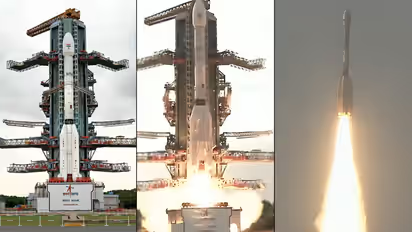
India launched one of its most important space missions on July 30. The satellite, called NISAR (NASA-ISRO Synthetic Aperture Radar), was launched at 5:40 PM IST from Sriharikota, Andhra Pradesh. It was carried into space on the GSLV-F16 rocket from the Satish Dhawan Space Centre.
ISRO posted on X: ‘Liftoff And we have liftoff! GSLV-F16 has successfully launched with NISAR onboard’.
NASA also posted about the lift off on X:
This satellite is a joint effort between India’s space agency ISRO and the US space agency NASA. It is the most expensive Earth imaging satellite ever built. The total cost of the mission is around $1.5 billion.
What NISAR will do
NISAR, weighs 2,392 kg, will orbit the Earth every 97 minutes. It will use two powerful radar systems, NASA's L-band and ISRO's S-band, to take pictures of the Earth's surface. These pictures will be taken day and night, in all weather conditions.
The satellite will cover almost the entire Earth, especially parts of ocean's surface and ice surfaces, every 12 days. It is designed to detect even tiny changes, like the movement of land by just a few millimetres. It can see through forests, clouds, and even at night.
NISAR: Milestone for India
India faces many natural disasters like earthquakes, floods, droughts and landslides. NISAR will help India track such disasters early and respond quickly. It will also help monitor glaciers in the Himalayas, track farm growth, manage water, and even detect fault lines underground.
The best part is that the data will be free and shared quickly. This means scientists, disaster teams and government officials can use it to make fast, informed decisions.
ISRO-NASA partnership
NISAR is also a great example of teamwork between two countries. NASA and ISRO scientists worked together for nearly 10 years to build this satellite.
NASA made the L-band radar and a 12-metre wide reflector. ISRO made the S-band radar and the satellite structure. The parts were built separately and then put together and tested in India at ISRO’s UR Rao Satellite Centre.
NISAR's mission in space
After the successful launch, NISAR mission will now go through these stages:
- Deployment: NASA's large radar reflector will unfold in space using a special arm.
- Commissioning: In this 90-day phase, all systems will be checked and tested. ISRO said that these days will be dedicated to In-Orbit Checkout to prepare observatory for science operations.
- Science Operations: The satellite will start full-time work, sending data back to Earth for research and public use.
This mission is not just about technology. It is about helping the planet. By tracking Earth's changes closely, NISAR will help us act faster during disasters and plan better for the future.
(With ANI inputs)