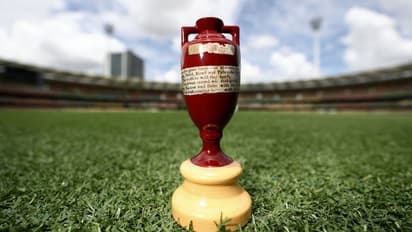
As England and Australia walk out in Perth this Friday, the weight of 143 years of fierce rivalry trails behind them. The Ashes, born in 1882, has never been just another Test series—it is cricket’s longest-running battle of pride, character and sheer stubbornness.
Ahead of the latest chapter, we revisit five unforgettable contests—moments when players crossed from being cricketers into folklore.
Few series have swung so violently between despair and disbelief as the 2019 Ashes. Australia arrived as defending champions and left with the urn, but the story of the summer belonged to two men at opposite ends of the emotional spectrum: Steve Smith and Ben Stokes.
Smith, returning from a ball-tampering ban, was met with boos, sandpaper masks and a barrage of jeers. He responded with numbers so outrageous they scarcely feel real: 774 runs in seven innings, averaging more than 110, including twin hundreds at Edgbaston.
Had he not missed three innings after being struck by a Jofra Archer bouncer, he might well have challenged Donald Bradman’s 974-run record from 1930.
But nothing that year topped what unfolded at Headingley.
With England staring at defeat—one wicket left, 73 still needed—Stokes launched one of the most audacious counterattacks the game has ever seen. Protecting a bespectacled Jack Leach at the other end, Stokes carved an unbeaten 135 to drag England to 362-9, their highest successful chase in Test history.
It wasn’t just a rescue act; it was a rewritten script.
The 2005 Ashes remains a piece of living memory for anyone who watched it. England had not lifted the urn in nearly 19 years, and Australia’s dominance was suffocating. The first Test at Lord’s followed the usual script: Australia crushed England by 239 runs.
Then fate intervened.
On the morning of the second Test, Glenn McGrath trod on a stray ball, ruled out with an ankle injury. Suddenly, the series cracked open. Andrew Flintoff—equal parts showman and workhorse—took charge. When Australia, chasing 282, slipped to 175-8, home fans breathed easy. But Australia clawed their way back before Michael Kasprowicz gloved behind off Steve Harmison, sealing a heart-stopping two-run win for England.
Trent Bridge brought another thriller, England clinging on despite a venomous burst from Shane Warne. And on the final day at The Oval, with the urn slipping away again, Kevin Pietersen produced a career-defining 158, supported by Ashley Giles’ gritty fifty. The draw was enough. After nearly two decades, the Ashes returned to England.
Occasionally in sport, a series becomes synonymous with a single name. For 1981, that name is Ian Botham.
He began the summer as England captain but resigned in despair after a pair at Lord’s and a loss at Trent Bridge. What followed defied logic.
At Headingley, England were given a 500/1 chance of winning after being forced to follow on. Botham’s incendiary 149 not out forced Australia to chase 130, only for Bob Willis to storm through with 8-43, sealing an 18-run victory that remains one of the most dramatic turnarounds in Test history.
Edgbaston brought a spell scarcely believable even today—Botham took five for one in 28 balls, delivering a 29-run win. At Old Trafford, he blasted 118, setting up a 103-run victory as England captured the series 3-1.
Rarely has a single player bent a series entirely to his will.
Australia’s 1948 side didn’t just win—they devoured opposition. Led by Don Bradman in his final Test series, the “Invincibles” went unbeaten through the tour, winning the Ashes 4-0.
Their dominance peaked at Headingley, where they chased a seemingly impossible 404 runs with just three wickets down. Arthur Morris struck 182, Bradman an unbeaten 173—a masterclass in controlled aggression.
Yet the tour is remembered most for a single delivery at The Oval. Bradman, needing just four runs in his final innings to finish with a Test average of 100, walked out to a standing ovation. Moments later, he was bowled by Eric Hollies for a duck.
The greatest batsman in history closed his career with an average of 99.94—a number both immortal and agonising.
If 1948 symbolised dominance, then 1932-33 was cricket’s darkest controversy. Bradman’s unparalleled scoring left England panicking for answers. Captain Douglas Jardine believed he had one: “leg theory”. Fast, short-pitched bowling aimed at the body, a packed leg-side field, and Harold Larwood as the spear.
It worked. England won the series 4-1, and Bradman’s average dipped to 56.57—a human number for an inhuman player.
But the tactic, later christened “Bodyline”, outraged Australia. Batsmen were forced to defend themselves, not their wickets. The series drove the nations to diplomatic breaking point, leaving scars that took years to heal.
From Stokes’ audacity to Botham’s defiance, from Bradman’s brilliance to the fury of Bodyline, the Ashes has delivered sport at its most raw and unforgettable.
As England and Australia prepare to renew hostilities in Perth, players will feel the weight of those who came before—and the knowledge that a single moment, a single innings, can etch their name into cricket’s longest-running epic.