West Asia tensions may speed up global shift to renewable energy: Report
Synopsis
A Jefferies report warns West Asia tensions risk disrupting oil routes like the Strait of Hormuz, which could accelerate a global shift to renewables. Oil-importing nations like Japan and South Korea may speed up this transition for energy security.
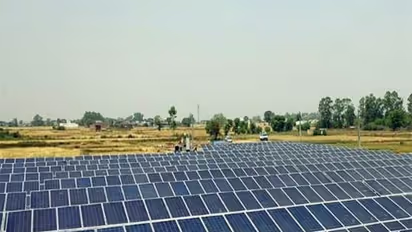
The ongoing tensions in West Asia and risks to key oil supply routes such as the Strait of Hormuz could accelerate the global shift towards renewable energy, especially among oil-importing nations, according to a report by Jefferies. The report noted that instead of focusing on short-term windfall gains from rising oil prices, there are growing concerns about the long-term risks posed by disruptions in energy supply. It highlighted that oil-importing countries may respond to such shocks by speeding up investments in renewable energy and electrification, a trend it referred to as "electrotech." It stated, "oil-importing countries will react to the shock of the closure of the Strait of Hormuz by opting for accelerating the expansion into renewables".
Existential Risk a Trigger for Change
According to Jefferies, the potential closure or disruption of the Strait of Hormuz presents an "existential risk" for economies heavily dependent on fossil fuel imports. This risk could act as a strong trigger for countries to reduce reliance on traditional energy sources and diversify towards cleaner alternatives.
Asian Nations Highly Vulnerable
The report emphasised that the incentive to reduce dependence on Middle East oil producers, as well as other fossil fuel suppliers, is particularly strong in Asia. Countries such as Japan and South Korea continue to have a high dependence on net fossil fuel imports as a share of primary energy demand. Japan's dependence stands at 84 per cent, while South Korea's is at 80 per cent, making them highly vulnerable to supply disruptions and price shocks. In comparison, the dependence is relatively lower for India at 37 per cent and China at 24 per cent.
Reflecting the urgency of the situation, South Korea's President Lee Jae-myung had said on March 30, "This is an emergency situation, and we must shift to renewable energy very quickly." The report suggests that geopolitical risks and energy security concerns could play a key role in accelerating the global energy transition, particularly in regions with high import dependence. (ANI)
Stay updated with all the latest Business NewsShare Market NewsIPOsGold PriceDA Hike8th Pay CommissionAsianet News Official App