Viksit Bharat 2047 an immediate horizon, not a distant dream: FM
Synopsis
FM Nirmala Sitharaman outlines the vision for a developed nation, describing Viksit Bharat as a framework for zero poverty, universal education, and skilled employment. She called 2047 an immediate national horizon, a restoration of India's destiny.
Outlining the vision for a developed nation, Union Finance Minister Nirmala Sitharaman described Viksit Bharat as a framework for zero poverty, universal quality education, comprehensive healthcare, skilled employment, full economic participation of women, and technological leadership.
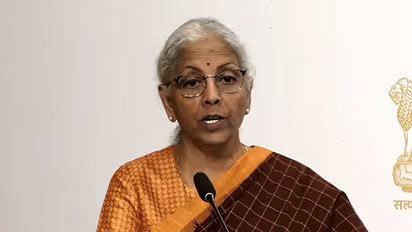
"Viksit Bharat is not an unprecedented ambition. In a way, it is a restoration. 2047 is no longer a distant aspiration. It is an immediate national horizon, and a good deal of it must be settled within the next few years," Sitharaman said while delivering the C.D. Deshmukh Memorial Lecture at the National Council of Applied Economic Research (NCAER) on Thursday.
She noted that India's destiny is to become prosperous without becoming consumerist, wealthy without becoming materialistic, and globally successful without losing our civilisational character. "Our model is neither consumerist nor mercantilist, as wealth has meaning only when it strengthens society as a whole," the Minister said.
A Historical Perspective on India's Economy
Detailing India's developmental journey from post-Independence economic challenges to current progress, Sitharaman stated that historical estimates show India accounted for roughly one-third of global GDP at the beginning of the Common Era. She noted that poverty was not the country's steady-state, but was manufactured through centuries of invasions and colonialism, and prolonged for four decades after Independence.
Critique of Early Governance Models
Reflecting on early governance choices, the Finance Minister highlighted how central planning models and the Licence-Quota-Permit Raj concentrated discretionary authority within state administrative machinery, moving investment decisions from the market to bureaucrats and political executives.
"Permit-licence-quota raj, which sits heavily over all national production and trade, was conceived with the intention of preventing chaotic development and illegal exploitation; but in fact it has impeded development and actually promotes exploitation," Sitharaman said, quoting C. Rajagopalachari from a 1963 essay titled 'Workman Quarrels With His Tools'. "What appears as progress has been achieved in spite of the incubus, and not on account of the regimentation."
Sitharaman pointed out that early policy choices overlooked exports and global trade at a time when East Asian economies built growth models around them. She added that the 1991 reforms were undertaken amid an acute Balance of Payments crisis, making them reforms born of compulsion rather than choice.
Economic Shifts and Reforms Post-2000
Addressing post-2000 economic shifts, the Finance Minister explained that physical connectivity, economic development, and digital infrastructure moved to the top of the national agenda. While the 2008 Global Financial Crisis tested major economies, domestic household savings and conservative banking regulations provided resilience. However, subsequent fiscal deficits, widening subsidies, high inflation, and 'Phone-Banking' presented renewed structural difficulties.
Reforms Post-2014
The Minister stated that post-2014 reforms prioritised financial inclusion, formal inflation targeting, transparent recognition of Non-Performing Assets, and the Insolvency and Bankruptcy Code (IBC) 2016.
Viksit Bharat: A Civilisational Ambition
"While we talk of Viksit Bharat at 2047, it is only a milestone in our larger civilisational arc. Our destiny is not preordained. It is as much as we put in it. The choices we make, the institutions we strengthen, our civilisational roots and the legacy we leave will determine it. It is shaped, not received. Our ambition is to create a grand society where modern progress is anchored in our civilisational heritage," Sitharaman concluded. (ANI)
(Except for the headline, this story has not been edited by Asianetnews Editorial staff and is published from a syndicated feed.)Stay updated with all the latest Business NewsShare Market NewsIPOsGold PriceDA Hike8th Pay CommissionAsianet News Official App