Union Budget 2026 Key Highlights: What You Need to Know in 5 Minutes
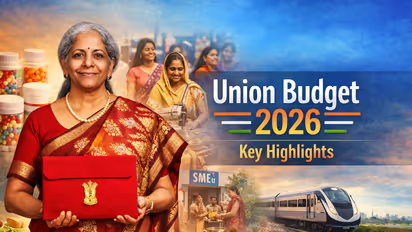
Synopsis
Union Budget 2026–27 focuses on growth with discipline, boosting manufacturing, services, MSMEs, infrastructure and welfare while keeping fiscal deficit at 4.3% and targeting Viksit Bharat.
The Union Budget 2026–27, presented by Finance Minister Nirmala Sitharaman on Sunday, lays out the government’s economic roadmap anchored in the principles of Action Over Ambivalence, Reform Over Rhetoric and People Over Populism. Rooted in the vision of Viksit Bharat, the Budget balances ambition with inclusion while reinforcing macroeconomic stability through moderate inflation, sustained growth, fiscal discipline and stability.
The government aims to sustain a high growth rate of around 7%, driven by reduced critical import dependencies, far-reaching structural reforms, fiscal prudence, monetary stability and a strong thrust on public investment. Citizens are placed at the centre of policy action, with the Budget positioning domestic manufacturing capacity, energy security and infrastructure expansion as key growth drivers.
The stated aim of Budget 2026–27 is to transform aspiration into achievement and convert potential into performance.
Yuva Shakti–Driven Budget and Government’s Sankalp
The Budget is driven by Yuva Shakti and focuses on the poor, underprivileged and disadvantaged sections of society. The government’s Sankalp is aimed at:
- Accelerating and sustaining economic growth
- Fulfilling the aspirations of the people
- Advancing the vision of Sabka Saath, Sabka Vikas
The Three Kartavyas
First Kartavya
- Enhancing productivity and competitiveness
- Building resilience to volatile global dynamics
Second Kartavya
- Building people’s capacity
- Making citizens strong partners in India’s path to prosperity
Third Kartavya
- Ensuring every family, community, region and sector has access to resources, amenities and opportunities for meaningful participation
Sustaining the Momentum of Structural Reforms
Structural reforms are described as continuous, adaptive and forward-looking. The Budget underlines the role of:
- A robust and resilient financial sector
- Cutting-edge technologies, including AI applications, as force multipliers for better governance
- Efficient allocation of capital, risk management and mobilisation of savings
India’s Reform Express
- The government has undertaken comprehensive economic reforms aimed at job creation, productivity enhancement and growth acceleration
- Over 350 reforms have been rolled out
- These include GST simplification, notification of Labour Codes, and rationalisation of mandatory Quality Control Orders
- High-Level Committees have been formed
- The Central Government is working with State Governments on deregulation and reduction of compliance requirements
Pillars of Growth and Development
The Budget is structured around the following pillars:
- Sustaining Economic Growth
- Strengthening the Foundations of Growth
- People-Centric Development
- Trust-Based Governance
- Ease of Doing Business and Ease of Living
- Fiscal Matters
1. Sustaining Economic Growth
1.1 Manufacturing: Strategic and Frontier Sectors Major Initiatives
- Revival of 200 legacy industrial clusters
- Biopharma SHAKTI
- Electronics Components Manufacturing Scheme
- Integrated Programme for Textiles
- 3 Dedicated Chemical Parks
- Container Manufacturing Scheme
- India Semiconductor Mission (ISM) 2.0
- Rare Earth Permanent Magnets scheme (research, mining, processing, manufacturing)
- Hi-Tech Tool Rooms in CPSEs
- Affordable Sports Goods Manufacturing Initiative
Tax Reforms to Boost Manufacturing
- 5-year income tax exemption for non-residents supplying capital goods/tooling in bonded zones
- Safe harbour for non-residents for component warehousing
- Deferred duty payment window for trusted manufacturers
- Duty-free import limit for seafood processing inputs raised from 1% to 3% of FOB value
- Duty-free imports extended to shoe uppers
- Export period extended from 6 months to 1 year for leather and textile exporters
- Customs duty exemptions for - Microwave oven parts, Aircraft manufacturing components, Aircraft MRO raw materials for defence
- One-time concessional duty sale in DTA for eligible SEZ units
- Electronic sealing for export cargo from factory to port
MSMEs: Three-Pronged Growth Strategy
Equity Support
- ₹10,000 crore SME Growth Fund
- ₹2,000 crore top-up to Self-Reliant India Fund
Liquidity Support via TReDS
- Mandatory TReDS usage by CPSEs
- CGTMSE credit guarantee for invoice discounting
- Linking GeM with TReDS
- TReDS receivables to be securitised
Professional Support
- ‘Corporate Mitras’ in Tier-II and Tier-III towns
- Tax Proposal: Removal of ₹10 lakh cap per consignment on courier exports.
1.2 Renewed Focus on Services Sector
Health & Medical Tourism
- Five Medical Value Tourism hubs with States & private sector
- Education-to-Employment Standing Committee
- New and upgraded Allied Health Professional institutions
- Training 1.5 lakh multiskilled caregivers
- 3 new All India Institutes of Ayurveda
- Strengthening AYUSH labs and WHO Traditional Medicine Centre
Orange Economy, Sports & Design
- AVGC Creator Labs in 15,000 schools & 500 colleges
- New National Institute of Design in eastern India
- Khelo India Mission with integrated talent pathways
Education & Tourism Push
Education
- 5 University Townships near industrial corridors
- Girls’ hostels in STEM institutions in every district
- Four telescope infrastructure facilities
Tourism
- National Destination Digital Knowledge Grid
- Eco-trails: Mountain, Turtle & Bird Watching
- Global Big Cat Summit hosted by India
- 15 archaeological sites developed
- Upskilling 10,000 tourist guides
- National Institute of Hospitality
- Buddhist Circuit development in Northeast
Services Sector Tax Reforms
- IT services under single category with 15.5% safe harbour
- Safe harbour threshold raised from ₹300 crore to ₹2,000 crore
- Automated APA approvals
- Safe harbour extended up to 5 years
- Fast-track APA completion within 2 years
- Tax holiday till 2047 for foreign cloud companies via India data centres
- 15% safe harbour for data centre entities
- Global income exemption for non-resident experts (5 years)
Financial Sector Reforms
- ₹100 crore incentive for municipal bond issuances above ₹1,000 crore
- Restructuring of PFC and REC
- FEMA Non-Debt Instruments review
- Market-making framework for corporate bonds
- Total Return Swaps introduction
- High-Level Committee on Banking for Viksit Bharat
Tax Proposals
- STT on Futures: 0.02% → 0.05%
- STT on Options: 0.1–0.125% → 0.15%
Tax Proposals: Agriculture & Cooperatives
- Duty-free fish catch in EEZ and High Seas
- Foreign port landing treated as exports
- Expanded deductions for cooperative societies
- Dividend tax exemption for national cooperative federations (3 years)
1.3 Increasing Farmers’ Income
Key Focus Areas
- Fisheries value chain & 500 reservoirs
- Coconut Promotion Scheme
- Cashew & Cocoa Programmes
- High-value horticulture & orchard rejuvenation
- Veterinary & para-vet infrastructure via capital subsidy
- Bharat-VISTAAR with AI-enabled AgriStack integration
2. Strengthening the Foundations of Growth
Infrastructure Push
- Infrastructure Risk Guarantee Fund
- CPSE real estate monetisation via REITs
- New Freight Corridor: Dankuni–Surat
- 20 new National Waterways
- Coastal Cargo Promotion: share to rise from 6% to 12% by 2047
- Seaplane VGF Scheme
- ₹2 lakh crore SASCI support to States
- Purvodaya East Coast Industrial Corridor
Public Capex
- ₹12.2 lakh crore in FY27 (up from ₹2 lakh crore in FY15)
Energy Security & Green Transition
- ₹20,000 crore CCUS Scheme
- Customs duty exemptions for: Lithium-ion battery capital goods, Solar glass raw materials, Nuclear power projects till 2035, Critical minerals processing
- Full excise exemption on biogas portion in blended CNG
Urbanisation: City Economic Regions
- Focus on Tier-II, Tier-III cities & temple towns
- 7 High-Speed Rail Corridors: Mumbai-Pune, Pune-Hyderabad, Hyderabad-Bengaluru, Hyderabad-Chennai, Chennai-Bengaluru, Delhi-Varanasi and Varanasi-Siliguri
3. People-Centric Development
- Care ecosystem for elderly
- SHE Marts for women SHGs
- Divyangjan Kaushal & Divyang Sahara Yojanas
- Scaling ALIMCO with AI integration
- NIMHANS-2 & upgraded mental health institutes
- Trauma & emergency centres in district hospitals
4. Trust-Based Governance
- Duty deferral doubled to 30 days for Tier II & III AEOs
- Advance ruling validity extended to 5 years
- Automated customs notifications
- Warehouse operator-centric customs framework
5. Ease of Doing Business & Living
Major Taxpayer-Friendly Measures
- PROIs allowed PIS equity investments
- Motor accident compensation interest tax-exempt
- TCS on overseas tours cut to 2%
- LRS TCS for education/medical reduced to 2%
- Automated lower TDS certificates
- Return revision deadline extended to 31 March
- MAT exemptions for non-residents
- Amnesty & disclosure schemes
- Decriminalisation of procedural lapses
- Customs Integrated System rollout in 2 years
- Exempt BCD on 17 drugs or medicines for cancer patients
6. Fiscal Matters & Deficit Management
Finance Commission
- 41% vertical devolution retained
- ₹1.4 lakh crore grants to States in FY27
Fiscal Deficit
- FY26 RE: 4.4% of GDP
- FY27 BE: 4.3% of GDP
Debt Targets
- Debt-to-GDP: 55.6% in FY27
- Target: 50±1% by 2030
Where the Rupee Comes From & Goes
Revenue Sources
- Income Tax: 21%
- Corporation Tax: 18%
- GST & other taxes: 15%
Expenditure Heads
- States’ tax share: 22%
- Interest payments: 20%
- Defence: 11%
- Central Sector Schemes: 17%
Major Sectoral Expenditure (₹ crore)
Transport: 5,98,520
Defence: 5,94,585
Rural Development: 2,73,108
Home Affairs: 2,55,234
Agriculture and Allied Activities: 1,62,671
Education: 1,39,289
Energy: 1,09,029
Health: 1,04,599
Urban Development: 85,522
IT and Telecom: 74,560
Commerce and Industry: 70,296
Social Welfare: 62,362
Scientific Departments: 55,756
Tax Administration: 45,500
External Affairs: 22,119
Finance: 20,649
Development of North East: 6,812
Stay updated with all the latest Business NewsShare Market NewsIPOsGold PriceDA Hike8th Pay CommissionAsianet News Official App