Oil Markets on Edge: Saudi Aramco CEO Warns of ‘Catastrophic’ Fallout from Middle East War
Synopsis
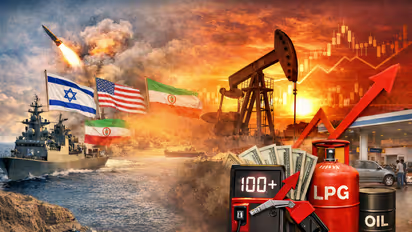
Saudi Aramco CEO Amin Nasser warns the Middle East war could have “catastrophic consequences” for global oil markets as the Strait of Hormuz remains shut, disrupting nearly 20% of the world’s oil supply.
The escalating war in West Asia is beginning to send shockwaves through global energy markets, and the head of Saudi Arabia’s state oil giant has issued a stark warning about what could lie ahead. Speaking during a media call on Tuesday, Amin H. Nasser, president and CEO of Saudi Aramco, said the ongoing conflict could trigger severe and lasting disruptions across the world’s oil supply chain.
Describing the situation as unprecedented for the region’s energy industry, Nasser warned that the longer the crisis continues, the more damaging its consequences could become for both oil markets and the broader global economy.
‘Catastrophic consequences’ for oil markets
The conflict has already caused sharp volatility in oil prices and major disruptions to shipping routes. According to Nasser, the situation is unlike anything the region’s oil and gas sector has faced in recent decades.
“The disruption has caused a severe chain reaction in not only shipping and insurance but there's also a drastic domino effect on aviation, agriculture, automotive and other industries,” Nasser said.
He added that the crisis could escalate further if the disruption continues.
“There would be catastrophic consequences for the world's oil markets the longer the disruption goes on, and the more drastic the consequences for the global economy.”
“While we have faced disruptions in the past, this one by far is the biggest crisis the region's oil and gas industry has faced.”
The remarks come at a time when energy markets are reacting sharply to developments in the war.
Strait of Hormuz closure raises alarm
One of the biggest concerns is the closure of the Strait of Hormuz, a narrow but crucial maritime corridor through which nearly 20 percent of the world’s oil supply normally flows.
Nasser stressed that reopening the route is essential to stabilise global energy markets.
“It's absolutely critical that shipping resumes in the Strait of Hormuz,” he said.
The waterway has effectively been shut amid the ongoing military escalation involving Iran, the United States, and Israel, sending shockwaves through the energy sector.
Oil prices swing wildly
The uncertainty surrounding supply routes has triggered dramatic movements in crude prices.
Oil surged nearly 30 percent on Monday amid fears of supply disruptions before falling again after Donald Trump suggested the war could soon come to an end.
The rapid price swings underline how sensitive global markets remain to developments in the conflict.
Energy infrastructure under attack
The crisis has also begun to directly affect oil infrastructure across the Gulf.
Iran has launched drone and missile attacks on several US-allied Gulf states over the past 11 days, retaliating after a large-scale aerial campaign against Tehran began on February 28.
Among the targets was Aramco’s massive Ras Tanura Refinery, one of the largest refining complexes in the Middle East. The strike forced the facility to halt some operations.
The refinery is a cornerstone of Saudi Arabia’s energy industry and plays a key role in global oil exports. Several Saudi oil fields have also reportedly been targeted during the attacks.
Elsewhere in the Gulf, Al Ma'ameer Oil Facility in Bahrain was hit on Monday, sparking a fire and causing significant damage.
Following the strike, the country’s state energy company Bapco declared force majeure, warning that events beyond its control may prevent it from fulfilling supply contracts.
Similar declarations have already been made by energy producers in Qatar and Kuwait.
Aramco earnings dip amid economic headwinds
The comments from Nasser came as Aramco released its financial results for 2025.
The company reported net income of $93.38 billion, down from $106.24 billion in 2024, marking a 12.1 percent decline.
Adjusted net income, excluding exceptional items, fell 5.1 percent to $104.65 billion, compared to $110.29 billion the previous year.
Higher global supply, US tariffs and broader economic pressures weighed on revenues, the company said.
Aramco also announced a share buyback programme worth up to $3 billion over the next 18 months, the first such initiative since the company launched its record-breaking public listing in 2019.
Global energy markets on edge
Even before the latest escalation, oil markets had been under pressure. The OPEC+ alliance — led by Saudi Arabia — increased production last year, adding more supply to the market and pushing prices lower.
Now, the war has dramatically altered the outlook.
With attacks on energy infrastructure, shipping disruptions in the Strait of Hormuz and rising geopolitical tensions, analysts warn that global oil markets could face prolonged instability if the conflict continues.
For now, the message from the world’s largest oil exporter is clear: restoring the flow of oil through the Gulf is critical — and the clock is ticking.
(With inputs from AFP)
Stay updated with all the latest Business NewsShare Market NewsIPOsGold PriceDA Hike8th Pay CommissionAsianet News Official App