Samsung to Supply HBM for AMD's Helios AI Server to Rival Nvidia
Synopsis
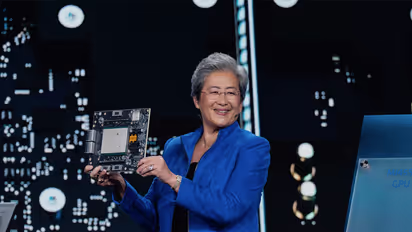
Samsung is supplying high-bandwidth memory for AMD's new Helios AI server rack, a system entering production to compete with Nvidia. AMD CEO Lisa Su announced the deal in Seoul, with shipments scheduled to begin late in the third quarter.
Samsung Electronics is supplying high-bandwidth memory for AMD's Helios AI server rack as the system enters production to compete against Nvidia in the data center market, according to a news report by The Korea Herald. AMD Chief Executive Officer Lisa Su announced the milestone on Thursday during the company's Advancing AI conference in Seoul.
Su stated that shipments were scheduled to start late in the third quarter before expanding into the fourth quarter.
Helios Specifications and Competitive Edge
Built as a complete cabinet rather than individual chips, every Helios unit integrates 72 Instinct MI455X accelerators together with central processors, networking gear, and cooling systems. The configuration supports up to 432 gigabytes of HBM4 per accelerator, totaling approximately 31 terabytes across the rack cabinet.
High-bandwidth memory stacks memory layers vertically beside an AI processor to speed up data delivery. Samsung's mass-produced HBM4 holds 36 gigabytes within a 12-layer stack, amounting to roughly twelve stacks per accelerator. By comparison, Nvidia's competing Rubin processor uses eight stacks, meaning each shipped AMD rack carries a higher volume of Samsung memory than a comparable Nvidia setup.
Comparing performance parameters, Su said Helios offers 50 per cent more memory capacity and 6 percent higher bandwidth than Nvidia's Vera Rubin platform. As per the news report, the figures reflect AMD's internal specifications rather than third-party benchmark evaluations.
Partnership and Technology Details
Samsung gained primary HBM4 supplier status for the MI455X under a contract signed in March at its Pyeongtaek chip facility, which Su visited during the agreement. Primary supplier status does not imply exclusivity, and neither firm disclosed pricing or volume allocation. Samsung initially began commercial HBM4 shipments in February.
During a Samsung-hosted session at the Seoul conference, Bart Walker, vice president of memory for the AMD account at Samsung Semiconductor US, and senior engineer James An explained the underlying technology. Samsung did not issue a separate press release for the presentation. Addressing the architecture, An said the HBM4 doubles the number of input-output connections to 2,000 from 1,000 in the previous generation, and that Samsung produced the logic layer beneath the memory stack on its own 4-nanometer foundry process. Samsung also supplies server memory modules for the sixth-generation EPYC "Venice" processors used in Helios.
Future Deployments and Commitments
AMD announced hardware commitments from OpenAI, Oracle, and Anthropic, though actual deployments operate on staggered timelines extending through 2027. (ANI)
Stay updated with all the latest Business NewsShare Market NewsIPOsGold PriceDA Hike8th Pay CommissionAsianet News Official App