Resilience, diversification driving global trade: Commerce Secretary
Synopsis
Commerce Secretary Rajesh Agrawal stated that supply-chain resilience, multiple sourcing, and diversification are becoming crucial drivers of global trade, moving beyond the traditional reliance on comparative advantage alone, as per the ANI report.
Supply-chain resilience, multiple sourcing and diversification are increasingly becoming important drivers of global trade alongside traditional comparative advantage, Commerce Secretary Rajesh Agrawal said, as geopolitical changes and past disruptions reshape how countries approach international trade.
New Drivers of Global Trade
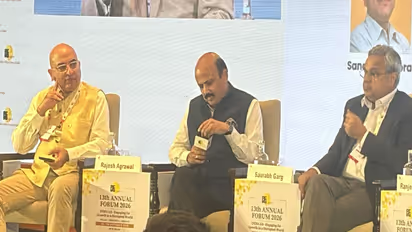
Speaking at the 13th Annual Forum 2026: India 3.0 – Engaging for Growth in a Disrupted World, Agrawal said India continues to support the World Trade Organization and a rules-based trading order, but countries are increasingly looking beyond sourcing from the most efficient producers.
“The world is looking at not only sourcing from the most efficient quarters, they are also looking at trying to build resilience by multiple sourcing, diversifying, creating the right domestic environment or domestic manufacturing ecosystem,” Agrawal said.
He said the COVID-19 pandemic showed that efficiency alone cannot protect supply chains from future shocks. “It is not only the most efficient producer that is important. It is also resilience that is important,” he said, adding that disruptions may not necessarily be geopolitical.
Agrawal said this was changing the traditional understanding of comparative advantage as the sole driver of international trade. “So this definitely impacts the complete theory of comparative advantage, that was the only key driver. There are multiple other factors which are driving trade,” he said.
India's Trade Strategy
However, he stressed that comparative advantage and the unique strengths of economies would remain at the core of global trade. India, he said, has therefore pursued free trade agreements based on the individual strengths and requirements of partner countries.
Agrawal also said the government is working to make export data more granular at the state level, as current data is largely based on where goods are shipped rather than where they are produced. State-wise export metrics are expected to be added to the Intelligence and Analytics portal shortly.
Focus on Infrastructure and Technology
Meanwhile, Department of Expenditure Secretary V Vualnam said central government capital expenditure has grown around five-fold over the last 10-12 years, with spending on railways, metro projects, highways and other infrastructure forming an important foundation for economic growth.
Statistics and Programme Implementation Secretary Saurabh Garg said technology has made government data collection and processing faster, with surveys increasingly conducted through tablets. He said this could enable real-time data availability at the national scale.
(Except for the headline, this story has not been edited by Asianet Newsable English staff and is published from a syndicated feed.)
Stay updated with all the latest Business NewsShare Market NewsIPOsGold PriceDA Hike8th Pay CommissionAsianet News Official App