RBI unlikely to increase policy rate anytime soon: Piramal's Chaudhuri
Synopsis
RBI is unlikely to increase the policy rate soon due to easing crude oil prices, says Piramal Group's Debopam Chaudhuri. The central bank is expected to maintain its 'wait and watch' approach in its upcoming August 2026 MPC meeting.
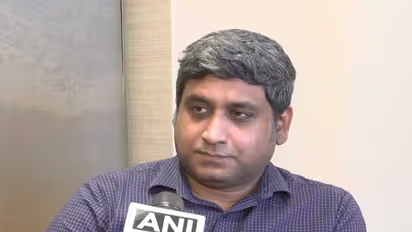
Reserve Bank of India (RBI) is unlikely to increase policy rate any time soon, according to Piramal Group Chief Economist, Debopam Chaudhuri. The Reserve Bank of India (RBI) Monetary Policy Committee (MPC) is scheduled to meet from August 3 to August 5, 2026, to review key policy rates.
"I don't expect the RBI to increase the policy rate anytime soon," Chaudhuri said, citing an easing of crude oil prices and lower energy-related risks as key reasons for the central bank to maintain its current monetary policy stance. In an interview with ANI, Chaudhuri said, "One, because the crude prices have come down, so the immediate risk of energy prices remaining high... has gone down to a great extent," adding that the central bank would prefer a "wait and watch" approach regarding the progression of the monsoon.
June MPC Meeting Outcome
The Reserve Bank of India's Monetary Policy Committee (MPC), in its meeting held from June 3 to 5, 2026, unanimously decided to keep the policy repo rate unchanged at 5.25% and retain the neutral policy stance, citing heightened uncertainty arising from the prolonged West Asia conflict, elevated global energy prices, supply chain disruptions, and concerns over a deficient monsoon.
The MPC projected India's real GDP growth for 2026-27 at 6.6% while revising Consumer Price Inflation (CPI) upward to 5.1%, with inflation expected to peak at 5.9% in the third quarter.
Although headline inflation remained below the target during March and April 2026, members expressed concern over possible second-round effects of rising fuel and input costs. The Committee concluded that, despite increased inflationary risks, the prevailing uncertainty warranted a wait-and-watch, data-dependent approach rather than immediate policy tightening. All six members voted in favour of maintaining the existing repo rate and neutral stance.
India's Long-Term Economic Outlook
The Piramal Group Chief Economist expressed confidence in India's long-term economic prospects, arguing that strong domestic demand drivers continue to insulate the economy from global uncertainties. "If you are asking about a longer-term perspective, India obviously is in a sweet spot, particularly because of our increasing middle-income population, which is increasing at a very fast pace... From a long-term perspective, economic growth in the range of 7% to 7.5% should not be difficult to achieve," he said.
According to Chaudhuri, India's rapidly expanding middle-income segment and young population remain the foundation of sustained economic growth, although successive global crises could result in a temporary slowdown around 2027.
Commodity Prices and Rupee Outlook
On commodities, he noted that gold prices are correcting as central bank purchases have moderated and geopolitical tensions in West Asia have eased. He added that lower crude oil prices are providing significant relief to the Indian economy.
"Our crude import bill is going to get a lot of relief... The concerns regarding our significantly rising current account deficit... have gone away," Chaudhuri said, adding that he expects the Rupee to stabilize around its historical average depreciation rate of 3 per cent to 3.5 per cent.
Chaudhuri's comments came after the US Federal Reserve kept its repo rate steady between 3.50 per cent and 3.75 per cent.
Sharing a similar outlook on the currency market, Anindya Banerjee, Head of Commodity and Currency Research at Kotak Securities, said the rupee's rise to a six-week high of 94.33 against the dollar was supported by both lower oil prices and strong capital inflows following the US-Iran peace deal. "The rupee is being supported from two sides at once -- cheaper oil on the trade account, and a strong, policy-driven wave of dollar inflows through the FCNR(B), ECB and debt routes on the capital account," Banerjee told ANI.
Banerjee also attributed the recent decline in gold and silver prices to a hawkish US Federal Reserve stance, but stressed that softer commodity prices are ultimately beneficial for India. "With oil and gold falling together, India's two biggest import bills are shrinking at the same time - which is doubly positive for the trade deficit and the rupee," he said. (ANI)
(Except for the headline, this story has not been edited by Asianet Newsable English staff and is published from a syndicated feed.)Stay updated with all the latest Business NewsShare Market NewsIPOsGold PriceDA Hike8th Pay CommissionAsianet News Official App