RBI's Rohit Jain on AI risks: Speed, concentration, opacity in finance
Synopsis
RBI Deputy Governor Rohit Jain flagged three key concerns with emerging tech in finance: the speed of automated decisions, concentration among tech providers, and opacity in advanced models, which can amplify risks in the financial system.
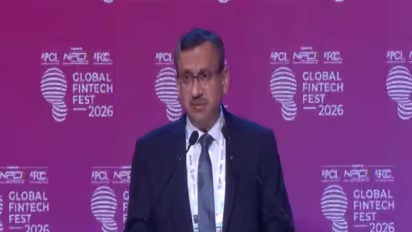
The growing use of artificial intelligence and other emerging technologies in finance could amplify risks related to the speed of automated decisions, concentration among technology providers and lack of transparency in advanced models, Reserve Bank of India (RBI) Deputy Governor Rohit Jain said on Wednesday.
Addressing the Global FinTech Festival 2026 in Mumbai, Jain said technology can make financial services faster, cheaper and more accessible, but greater use of automated and interconnected systems can also create new vulnerabilities for the financial system.
Three Key Concerns: Speed, Concentration, Opacity
“I see three key concerns [now] that emerging technologies become more deeply embedded in finance. Speed, concentration and opacity. None of these risks is entirely new, but technology can amplify them and allow their effects to travel through the financial system in ways that are faster, wider and sometimes harder to detect,” Jain said.
Risk from Speed
On the risk from speed, he said automated systems can analyse information and initiate actions much faster than human beings can respond.
“At machine speed, resilience cannot depend only on preventing every error. Institutions must also be able to detect problems early, contain their effects, and intervene before a small mistake becomes a much larger one,” he said.
Risk from Concentration
Jain also flagged the increasing dependence of financial institutions on a relatively small group of technology service providers.
“Financial institutions may increasingly depend on a relatively small number of cloud providers, technology vendors, and model providers, often using overlapping data sets and similar technological infrastructure,” he said.
He added that the concern was not limited to the failure of one financial institution, as a common technology dependency could transmit disruption or errors across several institutions at the same time.
Risk from Opacity
On opacity, Jain said advanced models can identify relationships and arrive at decisions in ways that may be difficult to explain. However, greater technological sophistication cannot lead to weaker accountability.
“An institution may outsource the computation, but it cannot outsource the consequence. A customer affected by an important financial decision deserves something more meaningful than being told that the model said so,” he said.
Jain said technology does not eliminate traditional financial risks such as borrower defaults, liquidity stress, leverage-related losses or operational failures. Instead, technology can significantly change their speed, scale and transmission.
The Regulatory Challenge
He also stressed the need for regulation to strike a balance between encouraging innovation and protecting financial stability.
“Regulate too early and we risk writing detailed rules for a technology we do not yet fully understand, or for an architecture that may change before the rules take effect. Regulate too late and the technology may already be deeply embedded before its risks are fully understood and addressed,” Jain said.
He said regulation should focus on outcomes such as fairness, accountability, resilience, customer protection and financial stability, while allowing space for experimentation under appropriate safeguards. “The greater the consequence of the use case, the stronger the expectations should be around governance, validation, oversight, and intervention,” Jain said.
RBI Launches New Forex Facility
At the event, Jain also launched RBI's Forex Multicurrency facility in collaboration with the Clearing Corporation of India Limited (CCIL) and NPCI Bharat BillPay Limited (NBBL).
The facility expands the FX Retail offering through Bharat Connect to five additional currencies - euro, British pound, Swiss franc, Canadian dollar and UAE dirham - alongside the US dollar. (ANI)
(Except for the headline, this story has not been edited by Asianet Newsable English staff and is published from a syndicated feed.)Stay updated with all the latest Business NewsShare Market NewsIPOsGold PriceDA Hike8th Pay CommissionAsianet News Official App