Over 60% of India's oil imports are price-driven: ONGC Chairman
Synopsis
Over 60% of India's oil imports are determined by prevailing crude prices, ONGC Chairman Arun Kumar Singh said. He added that ONGC is 'fairly balanced' against price volatility and prepared for a crude price range of USD 60-90 per barrel.
Price is the key driver for India's oil imports
India's oil imports from countries such as the US and Venezuela are largely determined by prevailing crude prices, with more than 60 per cent of the country's oil imports being a function of prices in a particular month or M+2, ONGC Chairman and CEO Arun Kumar Singh said on Monday.
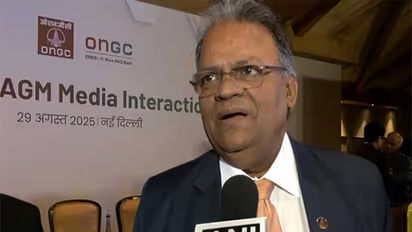
Responding to a question from ANI on the current status of India's crude oil imports from the US and Venezuela, Singh said imports by Mangalore Refinery and Petrochemicals Ltd (MRPL) are primarily driven by price, except in the case of term crude supplies. "Imports are decided by the price, except for term crudes. Now term crudes are gradually going down. Spot crudes are mostly decided cargo-to-cargo based on price. So, how much will be imported, we don't know. But it looks like at least 60 per cent plus of India's oil imports is a function of the price in that particular month or M+2," Singh said while interacting with media after ONGC's Annual General Meeting.
MRPL, a subsidiary of state-owned ONGC, imports crude oil for its refinery operations. Singh's comments come amid continuing shifts in global crude oil trade flows, with refiners assessing supplies from different sources based on price and prevailing market conditions.
ONGC's balanced model a cushion against price volatility
On the broader impact of crude oil price movements on ONGC, Singh said the company is "fairly balanced" against price volatility because of its integrated business model, with its exploration and production (E&P) and non-E&P businesses providing a cushion against fluctuations. "ONGC today, if you see, is almost 60-40. 60 per cent is E&P and 40 per cent is non-E&P. So, we are fairly balanced," Singh said.
He said ONGC is equipped to deal with different crude oil price scenarios as one part of its integrated operations can offset pressure on another. "Even if oil prices go down, we get compensated on the other half," he said.
Singh said downstream businesses can benefit when crude prices rise, helping offset pressure that may arise elsewhere in the company's operations. "ONGC's future will remain the same, regardless of the movement of oil price. Because the downstream side will make more if the crude price goes up," he said.
Prepared for $60-90 price range
The ONGC Chairman said the company is prepared for a crude oil price range of USD 60-90 per barrel. "60 to 90 range, we are ready for. On the strength of the fact that it is an integrated case," he said.
Singh also said ONGC's business profile has become significantly more balanced compared with its earlier predominantly upstream-focused structure.
No crude unavailability foreseen for India
Asked by ANI about a backup plan in case Russian oil imports stop, Singh said he did not foresee a situation where crude oil would become unavailable to India, while making it clear that his response was his personal view and not an official government position. "Gradually, our reading is that we don't foresee a situation where crude will not be available to India. Price could be a matter of opinion: what will be the price. But today, if all the problems of the world, man-made problems, are removed, we have 7 million barrels a day more crude than what we need in the world," he said.
Singh said geopolitical disruptions could affect crude supplies temporarily, but economic considerations would ultimately prevail. "Therefore, supply of crude is not an issue. It is some geopolitical issue which is causing trouble, and ultimately economics prevail. Geopolitical disturbances could be for some months or years, but ultimately world economy prevails," he said.
Economic impact depends on price
On the potential impact on India's economic growth if Russian oil imports were to stop, Singh said the impact would depend largely on the resulting price level. "That will depend on the price. Of course we import, suppose, USD 200 billion of oil and gas. If it is more, naturally it gets a dent," he said.
Singh noted that India's economy is now around USD 4 trillion and higher oil prices would have an impact but would not necessarily cause an extreme disruption. "It will matter, no doubt it will matter. But it is not to the extent that suddenly food will vanish from the plates of Indians. That is not going to happen," he said. (ANI)
(Except for the headline, this story has not been edited by Asianetnews Editorial staff and is published from a syndicated feed.)Stay updated with all the latest Business NewsShare Market NewsIPOsGold PriceDA Hike8th Pay CommissionAsianet News Official App