NSE IPO: Demand 'unexpectedly large', anchor book revised to Rs 6,250 cr
Synopsis
NSE CEO Ashish Kumar Chauhan said demand for the exchange's IPO is 'unexpectedly large'. The anchor book size was revised to Rs 6,250 crore from Rs 9,000 crore. The IPO opens on Sept 17 with a price band of Rs 1,700-1,785.
NSE IPO: 'Unexpectedly Large' Demand and Revised Details
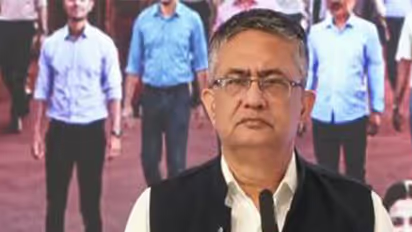
National Stock Exchange of India (NSE) Managing Director and CEO Ashish Kumar Chauhan has said the demand for the exchange's initial public offering (IPO) is "unexpectedly large", while the proposed anchor book size has been revised to around Rs 6,250 crore from the earlier planned Rs 9,000 crore.
"The demand (of the initial public offering of the National Stock Exchange of India) is unexpectedly large. I'm not at liberty to share with you the numbers. They are still negotiating with all those merchant bankers who get what and things like that. The book size has shrunk from earlier; the anchor book was supposed to be 9,000 crore. Now it's around 6,250 crore or something like that...The demand is much larger," Chauhan said.
NSE's IPO is scheduled to open for subscription on September 17 and close on September 21, with bidding for anchor investors scheduled for September 16. The exchange has fixed the price band at Rs 1,700 to Rs 1,785 per equity share. The IPO is entirely an offer for sale (OFS) of up to 12.64 crore equity shares by existing shareholders, with no fresh issue of shares by NSE.
High Profit Margins and Business Strategy
Earlier, in a conversation with ANI, Chauhan said NSE expects to maintain its high profit margins as it expands its product offerings, reaches more investors and explores newer geographies.
"Broadly speaking, over the last several years NSE has been running EBITDA margins of around 77 to 79 per cent, which converts into post-tax profits of around 55 to 57 per cent," he said.
Chauhan attributed the high margins to the platform-based nature of the exchange's business, where a significant portion of costs remain fixed. "It remains like that because it's a platform. And in platform, what happens is there are costs which are fixed," he said.
He said NSE has been able to control its two major cost areas, information technology and manpower, while continuing to expand its operations. "NSE has been able to control its large two major costs which are IT cost and manpower cost," Chauhan said.
He said adding new products and expanding the investor base without a corresponding increase in fixed costs could help the exchange maintain its margins. "If you are able to create newer products or increase your sales, then it helps your top line and bottom line both and that improves your EBITDA as well as PAT margins," he said.
Chauhan said NSE's future growth would depend on its ability to add new products, reach additional investors and enter newer geographies while maintaining control over costs. "If you are able to control and add newer products, go into newer additional investors, newer geographies, then we would continue to have sort of high margins going forward," he said.
Expanding Investor Base
He also highlighted the growth in NSE's investor base since the exchange began operations in 1994. From around one million investors at the time, NSE now has around 13 crore unique investors and 27 crore investor accounts, he said.
Chauhan said India's investor base could expand further with rising prosperity and the growth of the middle class.
Offer Specifications and Listing
The minimum bid lot for NSE's IPO has been fixed at eight equity shares and in multiples of eight thereafter. At the upper end of the price band, the offer size is around Rs 22,569 crore. The shares are proposed to be listed on the BSE. (ANI)
(Except for the headline, this story has not been edited by Asianet Newsable English staff and is published from a syndicated feed.)Stay updated with all the latest Business NewsShare Market NewsIPOsGold PriceDA Hike8th Pay CommissionAsianet News Official App