More Wind Energy Can Save India Rs 2 Lakh Crore by 2035: IWTMA
Synopsis
India can achieve net savings of ₹2 lakh crore by 2035 by increasing its wind energy capacity by 90 GW, says IWTMA Chairman Girish Tanti. He recommends a 40% wind to 60% solar power mix to better meet peak demand and reduce battery storage costs.
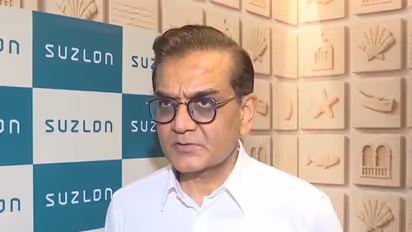
India stands to gain significant economic benefits by pivoting its renewable energy strategy toward a more balanced mix of wind and solar power. According to Girish Tanti, Chairman of the Indian Wind Turbine Manufacturers Association (IWTMA) and Vice Chairman of Suzlon, scaling up wind energy capacity by an additional 90 GW by 2035 could result in a net savings of ₹2 lakh crore for the nation's power system.
Economic Case for More Wind Power
Speaking to ANI at the Global Wind Day Conference in Goa, organised by the Ministry of New and Renewable Energy (MNRE), Tanti highlighted a new resource allocation report suggesting that India adjust its current wind-to-solar ratio to approximately 40% wind and 60% solar. "Effectively, there could be a period between now and 2035, if we increase the wind penetration by an additional 90 gigawatts, that can have an overall system saving of about Rs 2 lakh crores," Tanti said.
According to him, the report estimates total savings of about Rs 3 lakh crore, of which nearly Rs 1 lakh crore would be required for fresh capital expenditure, resulting in net savings of around Rs 2 lakh crore.
Tanti said the economics work in favour of wind because it generates power during periods of peak demand, unlike solar power, which requires battery support to shift electricity to morning and evening consumption periods. "The primary reason why this saving is coming is because, wind, you can produce when the peak power is required, morning and evening peak power demand," he said. "Solar, unfortunately, does not support the morning peak and evening peak. So effectively, when you generate more solar, you need more batteries," he added.
The report recommends increasing the share of wind energy in India's renewable energy mix from the current roughly one-to-three wind-solar ratio to about 40 per cent wind and 60 per cent solar. "If you can move it to about 40 per cent wind and 60 per cent solar, then the savings can come because you will need fewer batteries also and you will be generating when the consumer needs the power," Tanti said.
Transmission Hurdles a Major Challenge
However, even as the report highlights the economic case for accelerating wind deployment, Tanti said transmission constraints continue to delay projects already built on the ground. "As we speak, there are several gigawatts of wind turbines which are installed and waiting for transmission to come on stream," he told ANI.
According to Tanti, transmission planning continues to follow a four-to-five-year execution cycle, while renewable energy projects are now being developed within two to three years. "So transmission, there is a catch-up between that four-year cycle versus a two to three year cycle," he said.
He said green energy corridors and state-level transmission projects currently under implementation should help narrow the gap over the next two years. "In another two years, that catch-up should happen with the kind of plans the government is having," Tanti said.
Manufacturing Sector Prepared for Scale-Up
For manufacturers and suppliers, Tanti said the industry is already prepared for a significant scale-up in installations. "If you see as an industry, I think industry has almost 24 gigawatts of annual manufacturing capacity," he said.
"Whereas we are this year going to do about 8 gigawatts, the rest is very exporting. So there is enough and more capacity available from the manufacturing side," he added.
India on Track to Meet 2030 Climate Goals
Tanti also rejected suggestions that India is behind schedule in achieving its renewable energy and climate goals."We've achieved the first goal already for five years ahead of our target of 2030," he said, referring to India's target of having 50 per cent of installed power capacity come from non-fossil fuel sources.
He said India remains confident of achieving its target of 500 GW of non-fossil fuel capacity by 2030. "The visibility is already there to hit that, largely hit that goal. So we are very confident that in our first review period of 2030, we will hit the 500 gigawatt target," Tanti said.
Addressing Project Execution Hurdles
Apart from transmission challenges, Tanti said land-related and local law-and-order issues continue to affect project execution in certain locations. He added that the Ministry of Power and the Ministry of New and Renewable Energy are jointly reviewing project-level issues with states every month to accelerate implementation. "It's become a very operational project. And I think that's the reason we are confident that we will hit the 100 gigawatts target," he said. (ANI)
(Except for the headline, this story has not been edited by Asianet Newsable English staff and is published from a syndicated feed.)Stay updated with all the latest Business NewsShare Market NewsIPOsGold PriceDA Hike8th Pay CommissionAsianet News Official App