Mission Drishti: India's largest private satellite boosts space power
Synopsis
GalaxEye's Mission Drishti, India's largest privately built satellite, has successfully launched, marking a new era for India's space sector. The 190kg spacecraft features world-first OptoSAR technology for all-weather Earth observation.
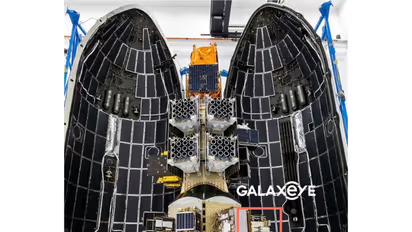
In a move that cements India's transition into a high-tier global space power, the successful launch of Mission Drishti on Sunday has signalled the arrival of a new, hybrid space ecosystem where private innovation meets national strategic goals. Developed by Bengaluru-based startup GalaxEye, the 190 kg satellite--India's largest privately built spacecraft to date--successfully reached orbit aboard a SpaceX Falcon-9 rocket.
The mission has drawn high-level praise from the Indian government, with External Affairs Minister S Jaishankar describing it as a reinforcement of India's "growing global standing" and a testament to the strengthening of the nation's technical and innovation ecosystems. "The success of Mission Drishti, world's first OptoSAR satellite by @GalaxEye reinforces India's growing capabilities in the global space sector. It also highlights the role being played by our entrepreneurs, strengthening nation's technical and innovation ecosystems," Jaishankar said in a post on X.
What is OptoSAR Technology?
The technical centrepiece of Mission Drishti is its OptoSAR technology, a world-first for a commercial satellite. While traditional satellites struggle with cloud cover or darkness, GalaxEye's "made-in-India" system fuses two distinct technologies: Optical Sensors, providing high-resolution, intuitive visual data and SAR (Synthetic Aperture Radar), penetrating clouds, smoke, and total darkness. By combining these in real-time, Drishti provides reliable, all-weather intelligence, offering a level of "predictable" data that was previously impossible with single-sensor platforms.
The success of Mission Drishti is not just a win for GalaxEye, but a validation of India's reorganised space sector. The project utilised a multi-layered support system: GalaxEye partnered with NewSpace India Limited (NSIL) for global data distribution and tested its tech using ISRO's orbital experiment modules. IN-SPACe facilitated the private-public partnership, opening state-of-the-art infrastructure for private testing. While building indigenous tech, the startup plugged into the global launch market via SpaceX, showcasing the "plug-and-play" capability of modern Indian space firms.
The satellite is a dual-use platform, making it highly valuable for both civilian and military applications. Global interest has already surged, particularly from defence partners in the Middle East, the United States, and Europe. Prime Minister Narendra Modi termed it "a major achievement" in India's space journey.
To understand why this matters, it is important to break down what OptoSAR means. Traditionally, satellites use either optical cameras -- similar to regular photographs that give clear visuals but fail during night or cloudy conditions -- or radar systems known as Synthetic Aperture Radar (SAR), which can "see" through clouds and darkness but produce less intuitive images. Mission Drishti brings both together.
As the company itself explained, "OptoSAR imagery enables insights that were impossible with traditional satellites," while being designed to be "reliable, predictable, and ready to power the next generation of applications." This marks a broader technological shift in Earth observation -- from relying solely on optical data or radar individually to a fused OptoSAR system that combines the strengths of both, enabling more accurate and reliable intelligence.
A New Hybrid Space Ecosystem
At 190 kg, the Mission Drishti satellite is "India's largest privately built satellite," and its launch aboard a SpaceX Falcon-9 rocket reflects how Indian startups are now plugging into global launch ecosystems while building indigenous capabilities.
Beyond the satellite itself, the deeper story lies in how India's public and private space institutions are working together. The Bengaluru-based startup, GalaxEye, has partnered with NewSpace India Limited, the commercial arm of Indian Space Research Organisation (ISRO), for the global distribution of its satellite imagery. This means the data generated by Mission Drishti can be marketed and accessed by government and commercial users, turning satellite output into a scalable data service.
The collaboration is backed by years of institutional support. The company's SAR technology was earlier tested using ISRO's PS4 Orbital Experiment Module (POEM), while the satellite itself underwent testing at ISRO's facilities, reflecting how India's legacy space infrastructure is now enabling private innovation.
Regulatory facilitation has also come from IN-SPACe, which has been tasked with opening the sector to private players. This layered ecosystem -- private innovation, public infrastructure, regulatory backing, and commercialisation -- is what Jaishankar's statement points to when he highlights "the role being played by our entrepreneurs, strengthening nation's technical and innovation ecosystems."
Dual-Use Platform with Global Demand
While developed in India, Mission Drishti is designed for global applications, with demand emerging across regions. The company has indicated strong interest in its datasets from international defence partners, particularly in the Middle East, the United States and Europe, reflecting the growing global relevance of high-resolution, all-weather satellite intelligence.
The implications of this are wide-ranging. Mission Drishti is a dual-use Earth observation Satellite, supporting use cases across defence, agriculture, disaster management, maritime monitoring, and infrastructure planning. In defence, such capabilities are critical for border surveillance and real-time tracking of assets even in adverse weather or at night, while civilian applications extend to areas such as infrastructure monitoring, insurance assessments and precision agriculture.
GalaxEye: The Startup Powering the Mission
GalaxEye, founded in 2021 by engineers from the Indian Institute of Technology Madras, represents this new generation of startups. "Mission Drishti... Launching May 3rd 2026. After years of building, testing and iterating, we are ready for orbit," the company said, calling it the culmination of years of work. The startup is led by CEO and Co-founder Suyash Singh and CTO and Co-founder Denil Chawda.
Taken together, Mission Drishti is not just about a single satellite in orbit. It reflects a broader transition -- from government-led space programmes to a hybrid ecosystem where startups, regulators, and national agencies work together to build technology, commercialise it, and position India as a competitive player in the global space economy, while also challenging the dominance of established global players in high-resolution Earth observation. (ANI)
(Except for the headline, this story has not been edited by Asianet Newsable English staff and is published from a syndicated feed.)Stay updated with all the latest Business NewsShare Market NewsIPOsGold PriceDA Hike8th Pay CommissionAsianet News Official App