India's middle class to drive 93% of spending by 2036: Sitharaman
Synopsis
Union Finance Minister Nirmala Sitharaman stated that India's middle class will account for 93% of spending by 2036. This growth is expanding beyond metros to 500 tier-2 and tier-3 cities, making the middle class the 'engines of growth'.
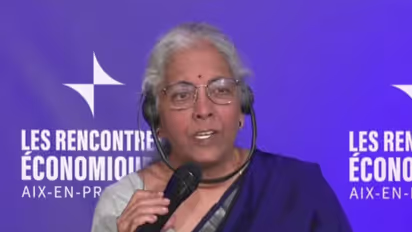
India's middle class is set to become an even bigger driver of growth, with 93% of all spending in India expected to come from middle-class and aspirational consumers by 2036, Union Finance Minister Nirmala Sitharaman said at the Rencontres Économiques d'Aix-en-Provence in France on Saturday.
She said the geographic base of this growth is also shifting. Nearly 500 cities are poised to emerge as new centers of economic activity, and unlike in many economies, India's middle class is not concentrated only in Mumbai, Delhi, Bengaluru or Chennai. "They are, on the contrary, in these tier two, tier three cities. So the distribution of wealth is actually automatically seen spreading to cities beyond the metropolitan," she noted.
Sitharaman called the middle class "not just a beneficiary of growth, but actually the engines of growth," pointing to consumption as the trigger for a virtuous cycle of economic activity. Today, 31% of India's population is middle class, and since 1995 the segment has grown at a 6.3% annual rate. As per OECD projections, India will surpass China in absolute middle-class population size between 2030 and 2035.
How Government Policy Supports the Middle Class
The Minister outlined how policy has sought to expand the middle class from lower-income groups. The first step was financial inclusion through Jan Dhan accounts, launched in 2014. She cited World Bank and IMF data that 248 million people have moved out of multidimensional poverty, many of whom entered the formal banking system through these accounts.
Financial Inclusion and Entrepreneurship
To support entrepreneurship, the government provided sovereign-guaranteed concessional loans so borrowers without collateral could start small businesses. Many have since graduated to larger loans and built credit scores, she said.
Digital Infrastructure
Digital infrastructure was the second pillar. Payments and banking were made accessible on feature phones and in regional languages, not just smartphones, helping informal businesses formalize and improving creditworthiness.
Taxation, Welfare and Skills Development
On taxation and welfare, Sitharaman said the income tax exemption limit was raised from Rs 0.25 million to Rs 1.2 million, putting more disposable income in households. The GST was cut across commodities to support consumption and small businesses. In health, every family gets Rs 5 lakh annual insurance cover under a cashless scheme, and citizens' pharmacies provide generic medicines at up to 80% lower cost. In skills, the government is funding girls' hostels in every district for STEM education and setting up five university townships for training. It is also skilling youth in AVGC -- audiovisual, graphics and gaming -- to serve India's film, OTT and export markets.
"Middle class is supported through these very measures. And they are today, therefore, an engine of India's growth," she said. (ANI)
Stay updated with all the latest Business NewsShare Market NewsIPOsGold PriceDA Hike8th Pay CommissionAsianet News Official App