Indian Railways unveils RailTech Policy, digitises Claims Tribunal
Synopsis
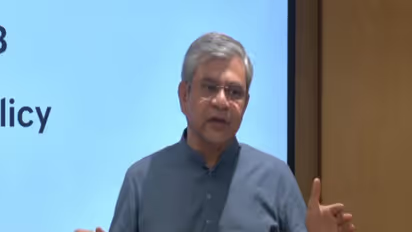
Railways Minister Ashwini Vaishnaw unveiled the RailTech Policy to engage startups for innovation and the full digitisation of the Railway Claims Tribunal (RCT), simplifying the claims process under the '52 Reforms in 52 Weeks' initiative.
Under the Indian Railways' flagship "52 Reforms in 52 Weeks" initiative, Union Railways Minister, Ashwini Vaishnaw on Thursday, announced the RailTech Policy and the complete digitisation of the Railway Claims Tribunal (RCT) as Reform Number Three and Reform Number Four.
RailTech Policy for Innovation
The Rail Tech Policy aims to engage "innovators, startups, industry and institutions to promote innovation in Indian Railways." The new policy simplifies the selection of innovators and introduces a dedicated "Rail Tech Portal" for innovation. Innovation challenges can be initiated by any innovator or departmental user, with a single-stage detailed submission of proposals. Key innovation areas include AI-based Elephant Intrusion Detection System (EIDS), AI-based fire detection system in coaches, drone-based broken rail detection system, rail stress monitoring system, sensor-based load calculation device on parcel vans (VPUs), solar panels on coaches, AI-based coach cleaning monitoring system, obstruction detection in foggy environments, and AI-based pension and dispute resolution systems.
Outlining the third reform, Vaishnaw said the RailTech Policy is designed to enable massive and systematic induction of technology into the Railways. He emphasised that "startups, researchers and innovators must be able to connect with Indian Railways in a structured, meaningful and simplified manner."
He said that anyone with a strong technological idea should be able to approach the Railways through a dedicated RailTech portal, which will function through a completely digital, end-to-end process. With this reform, the Railways have attempted to create a transparent, simplified and innovation-friendly ecosystem. He said that if successful, this model could serve as a template for other sectors as well.
Funding and Implementation
Explaining the funding structure, he noted that the Railways would support up to 50 per cent of the development funding required for the project. Once the project proves successful, substantial long-term orders would be placed to enable scaling of the solution. The policy is designed not merely to experiment but to ensure that successful innovations are implemented at scale.
He cited several potential application areas for innovation, including AI-enabled CCTV systems for passenger security and drone-based systems for detecting rail fractures, broken grills, and monitoring overhead equipment, including identifying overheating insulators through AI-based analytics. He also added that technology solutions could address administrative challenges such as faster processing of pension documents for retired railway employees, ensuring timely commencement of pension payments.
Digitisation of Railway Claims Tribunal (RCT)
In Reform Number Four, Vaishnaw announced the complete digitisation and AI-enabled transformation of the Railway Claims Tribunal (RCT). The E-RCT system will enable end-to-end computerisation and digitisation of the Railway Claims Tribunal. It will transform the filing, processing and adjudication of claims by making the process faster, more transparent and accessible from anywhere in the country.
Vaishnaw stated that there are 23 RCT benches across the country and that filing claims currently poses challenges, especially for passengers who may be travelling across states when an incident occurs. Determining the appropriate jurisdiction for filing a claim often becomes a significant issue. To tackle that, the new system allows aggrieved passengers to file claims electronically, irrespective of their location, even while travelling or upon reaching their destination. The entire process, from e-filing to case information systems will be digitised and AI-enabled. Vaishnaw stated that within the next 12 months, all benches of the Railway Claims Tribunal will be fully digitised under this initiative.
Earlier, claimants and advocates were required to physically visit Tribunal offices for filing cases, submitting documents and tracking case progress, which involved travel, time and procedural delays. With the introduction of the e-RCT System, cases can now be filed online from anywhere at any time, significantly improving accessibility, convenience and transparency for litigants. The Railway Claims Tribunal, constituted under the Railway Claims Tribunal Act, 1987, adjudicates claims against Railway Administration relating to compensation for death or injury in railway accidents and untoward incidents, loss or non-delivery of goods, and refund of fares and freight.
Previous Reforms under '52 Reforms' Initiative
Earlier this month, Vaishnaw announced two major reforms under the "52 Reforms in 52 Weeks" initiative, including continuous end-to-end cleaning of general coaches and expansion of the Gati Shakti Cargo Terminals to over 500 hubs to boost logistics capacity across Indian Railways. (ANI)
(Except for the headline, this story has not been edited by Asianet Newsable English staff and is published from a syndicated feed.)Stay updated with all the latest Business NewsShare Market NewsIPOsGold PriceDA Hike8th Pay CommissionAsianet News Official App