India's growth to slow below 7% in H2, but full year at 7.2%: Expert
Synopsis
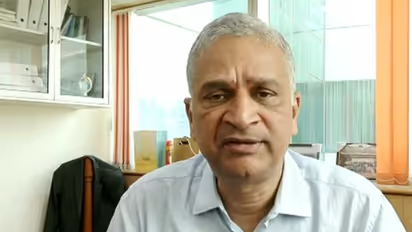
India's economic growth is poised to moderate below 7% in the latter half of the fiscal year, yet the full-year forecast remains at 7.2%, says economist Madan Sabnavis. He attributes the slowdown to monsoon impact and consumption trends.
India's economic growth is likely to moderate below 7 per cent in the second half of the financial year, but the economy could still grow around 7.2 per cent for the full year, while its longer-term potential remains around 8 per cent, economist Madan Sabnavis said.
Quarterly Projections and Moderation Factors
Speaking to ANI, Sabnavis said he expects growth of around 7.5-7.6 per cent in the second quarter, following 7.8 per cent growth in the first quarter, before slowing below 7 per cent in the third and fourth quarters. He said the moderation could reflect the impact of the monsoon and a possible slowdown in consumption.
“My sense is that in the second quarter too, we would have a similar kind of number, maybe not 7.8, but something more in the region of around 7.5, 7.6%,” Sabnavis said. He said the higher Q2 growth would receive some support from the base created by adjustments following the new GDP series, but that support would fade in the second half.
“Once I come into Q3 and Q4, … in terms of the monsoon, in terms of possible impact on consumption, we do expect growth rates to slip below 7% so that we average something closer to 7.2% for the entire year,” he said.
Long-Term Growth Potential
Despite the expected near-term slowdown, Sabnavis sees India's growth trajectory strengthening over the longer term. He said 8 per cent is India's potential growth rate, although the timing of reaching that level would depend on the global environment, oil prices, geopolitical developments and tariffs.
“Definitely, I think India's potential growth rate is 8%, something that should be achieved soon, hopefully in 27-28. But otherwise, definitely, I think by 28-29, we should be well above the 8% mark,” he said.
Global Bond Market Outlook
On global bond markets, Sabnavis expects uncertainty and volatility to continue for around six months, with investors assessing relative returns across markets and developments in the US. He said the yield differential between Indian and US bonds needs to be considered alongside the likely depreciation of the Indian rupee.
He noted that US Treasury yields were around 5.2-5.3 per cent, compared with around 7.2 per cent for Indian bonds, but said the headline yield gap does not by itself determine investment flows. “So I think this is something which will probably continue. There'll be a lot of volatility because at some point of time when there is more stability in the US environment, the way the Federal Reserve reacts to what's happening around, I think that's when we will see a bit of stability,” he said.
Sabnavis also pointed to differences in inflation and central bank rates to explain the gap between China's bond yields, below 2 per cent, and US yields of around 5.3 per cent. “When we are comparing any two different markets, it's not just the central bank rate,” he said, adding that inflation conditions have a major bearing on bond yields.
Looking ahead, he said India's near-term growth would face pressure from domestic and global uncertainties, even as the economy retains the potential to move towards a higher growth trajectory in the coming years. (ANI)
(Except for the headline, this story has not been edited by Asianetnews Editorial staff and is published from a syndicated feed.)Stay updated with all the latest Business NewsShare Market NewsIPOsGold PriceDA Hike8th Pay CommissionAsianet News Official App