India's auto industry set for record year amid festive demand surge
Synopsis
Hero MotoCorp's Vikram Kasbekar stated that India's auto industry is poised for a record year as festive demand outpaces supply for both ICE and EV vehicles, presenting a significant opportunity for manufacturers despite global challenges.
India's automobile industry is gearing up for a potential record year as festive demand rises across petrol-powered and electric vehicles, even as geopolitical uncertainties and global supply chain challenges continue, Vikram Kasbekar, Executive Director of Hero MotoCorp Ltd, said on Monday.
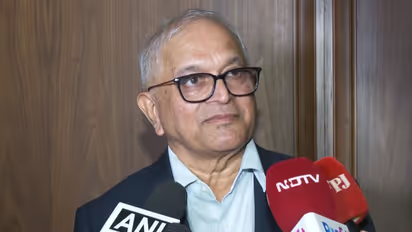
Speaking with reporters on the sidelines of CII's 17th Visionary Leaders for Manufacturing (VLFM) conference in Mumbai, Kasbekar said demand has outpaced supply in both internal combustion engine (ICE) and electric vehicle (EV) segments, creating an opportunity for manufacturers to increase production. "This is an opportunity that has come after a long time, when the industry has not been able to supply enough to meet demand. The situation is improving, and the automobile industry is gearing up to meet market requirements. Hopefully, this will be a record year for the industry," he said.
Navigating Global Headwinds
On the impact of global conflicts and rising commodity prices, Kasbekar said the company was prepared to manage cost pressures and meet market demand. He noted that fluctuations in commodity prices remain a concern but said Hero MotoCorp had not faced any significant challenges so far. The company is also expanding its electric vehicle business under the VIDA brand.
"There are definitely pressures from a commodity standpoint, and this is something we need to be prepared for. Such uncertainties are always a possibility. However, so far, we have not faced any significant problems and are well-equipped to meet market requirements," Kasbekar said.
Addressing Supply Chain Challenges
On supply chain challenges, particularly the availability of semiconductors and microcontrollers used in vehicles, he said companies were following their own sourcing strategies based on the specific components required for their products.
Kasbekar added that manufacturers identify the processors, controllers and other components needed for their vehicles before deciding how to source them. He also pointed to changing global demand for semiconductor components, driven partly by the growth of artificial intelligence (AI) technologies.
A Call for Self-Reliance and Innovation
Highlighting the need to reduce dependence on imports and strengthen India's manufacturing capabilities, Kasbekar said companies must invest in research and development (R&D), develop their own intellectual property (IP) and build technological expertise in-house. He said Indian manufacturers need to design and develop their own products, adopt global standards and strengthen their manufacturing capabilities to remain competitive in the long term.
Advice for Future Leaders
Kasbekar also urged young professionals entering the manufacturing sector to keep learning and adapt to changing technologies. "Learning is a continuous process; it never ends. Keep upgrading your knowledge, evolving, and adapting, and continue exploring different opportunities. Do not get into your comfort zone," he said. (ANI)
(Except for the headline, this story has not been edited by Asianetnews Editorial staff and is published from a syndicated feed.)
Stay updated with all the latest Business NewsShare Market NewsIPOsGold PriceDA Hike8th Pay CommissionAsianet News Official App