India's 6G rollout may be delayed beyond 2030, says COAI chief
Synopsis
India's 6G rollout could be delayed beyond 2030, says COAI's S P Kochhar. He warns that the lack of revenue-generating 5G applications is making telecom operators cautious about investing in the next-generation technology.
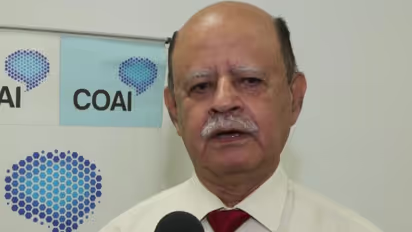
India's full-scale rollout of sixth-generation (6G) telecom networks may extend beyond the projected 2030 timeline, as uncertainty over revenue-generating applications could make operators cautious about investing in the next generation of technology, Cellular Operators Association of India (COAI) Director General S P Kochhar said.
Speaking to ANI on the sidelines of India Mobile Congress 2026 in New Delhi, Kochhar said that while 6G technology is expected to emerge around 2030, a complete rollout could take longer. "It is projected to be launched by 2030. It may get a little more delayed," he said.
Uncertainty Over 6G Monetisation
Explaining the challenge, Kochhar pointed to the lack of applications capable of generating substantial revenue from existing 5G networks, raising questions about the commercial viability of future 6G investments. "Since there are no killer applications in 5G, anybody who has to buy into 6G will have to think twice about whether there are going to be applications which can be monetised or not. So it may take a little more time before it rolls out," he said. He added, "Something will definitely come up in 2030. It may not be a full rollout."
Bharat 6G Vision and Global Standards
His remarks come as India pursues its Bharat 6G Vision, unveiled in March 2023, which aims to position the country as a leading contributor to the design, development and deployment of 6G technology by 2030. The government is targeting a 10 per cent share in global 6G patents and standards, while encouraging domestic research and participation in international technology development.
Kochhar said work on global 6G standards was underway through the 3rd Generation Partnership Project (3GPP), an international body that develops mobile telecommunications standards. He said India was actively participating in the process and working towards identifying practical applications for the technology. "Our environment has started filing a lot of patents. We are participating in the creation of standards. We are looking for use cases," he said.
Financial Pressures on Telecom Operators
Kochhar also highlighted the financial pressures facing telecom operators, warning that rising expenditure relative to income could make continued network expansion difficult without adequate returns. "Our gap between income and spending is increasing. So our profits are dwindling," he said.
He urged the government to reduce regulatory fees, levies and spectrum prices to ease the financial burden on operators. Kochhar said telecom companies remained committed to expanding their networks, but stressed that generating sufficient returns on investment would be essential to maintaining the pace of deployment.
He also indicated that higher consumer tariffs would be the industry's last resort if operating costs continued to rise. "I hope that the government reduces levies and fees on us so that we don't have to even look at tariffs. That's the last resort," he said. (ANI)
Stay updated with all the latest Business NewsShare Market NewsIPOsGold PriceDA Hike8th Pay CommissionAsianet News Official App