India launches new AI-based hyper-local weather forecasting systems
Synopsis
Union Minister Jitendra Singh launched two AI-enabled weather systems for hyper-local, impact-based forecasts. The systems will provide advance monsoon predictions and high-resolution rainfall data for UP, aiding farmers and disaster managers.
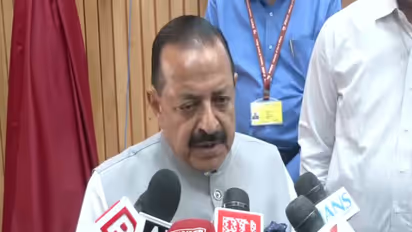
Union Minister of State (Independent Charge) for Science and Technology and Earth Sciences, Dr Jitendra Singh, on Tuesday launched two advanced weather forecasting systems developed under the Ministry of Earth Sciences (MoES), aimed at providing hyper-local, AI-enabled and impact-based weather services across the country.
Two New AI-Powered Systems
The newly launched systems include India Meteorological Department's (IMD) first Artificial Intelligence-enabled "Forecast of Monsoon Advance over Different Parts of the Country" and a "High Spatial Resolution Rainfall Forecast for Uttar Pradesh" as a pilot service. The products have been jointly developed by the India Meteorological Department (IMD), Indian Institute of Tropical Meteorology (IITM), Pune, and the National Centre for Medium Range Weather Forecasting (NCMRWF).
From Forecasting to Decision Support
Addressing the launch event in New Delhi, Jitendra Singh said India's weather forecasting capabilities had undergone a major transformation in the last decade with the use of advanced technologies, data integration and modern modelling systems.
"IMD has today become an integral component of governance, disaster preparedness, agriculture planning and everyday public decision-making," the Minister said. He further stated that the newly launched systems marked a shift from conventional forecasting to "impact-based and decision-support forecasting" capable of delivering precise and actionable information to farmers, disaster managers, administrators and citizens.
System Capabilities and Reach
According to the Ministry, the AI-enabled monsoon forecasting system will provide probabilistic forecasts of monsoon progression every Wednesday up to four weeks in advance. The service has been designed to support farmers across 16 states and more than 3,000 sub-districts through the dissemination network of the Ministry of Agriculture and Farmers' Welfare.
The second product -- a high spatial resolution rainfall forecast system for Uttar Pradesh -- has been developed as a pilot initiative to generate rainfall forecasts at 1-km spatial resolution up to 10 days in advance. Officials said the system integrates data from Automatic Rain Gauges, Automatic Weather Stations, Doppler Weather Radars and satellite-based rainfall datasets using AI-driven downscaling techniques.
Strengthening National Weather Infrastructure
Highlighting the expansion of India's weather infrastructure, Jitendra Singh said the country had only around 16 to 17 Doppler Weather Radars nearly a decade ago, while the number has now increased to about 50, with another 50 planned under Mission Mausam.
"Changing climate patterns and increasing extreme weather events have made precise and timely forecasting more important than ever before," he said.
Ensuring Last-Mile Connectivity
The Minister added that weather advisories and early warnings are now being disseminated through mobile applications, SMS alerts, WhatsApp, Kisan portals, television and other digital platforms to improve public outreach and last-mile connectivity. (ANI)
(Except for the headline, this story has not been edited by Asianet Newsable English staff and is published from a syndicated feed.)Stay updated with all the latest Business NewsShare Market NewsIPOsGold PriceDA Hike8th Pay CommissionAsianet News Official App