Govt may expand cost audit to infra, subsidised sectors for accountability
Synopsis
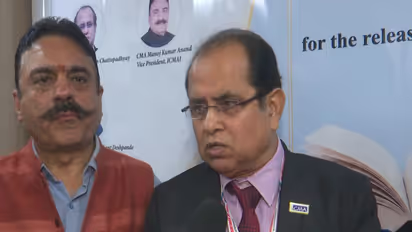
The government is considering expanding cost audit rules to the infrastructure sector and other areas receiving state subsidies to boost accountability and ensure better use of public funds, according to ICMAI Vice President Manoj Kumar Anand.
"Government is very much positive and is trying to expand it to the infrastructure sector and all other areas where government subsidy is going. The accountability of that money, whether it is cost effective and optimised, is important," Anand told ANI.
ICMAI's Role in Enhancing Efficiency
Speaking with ANI on the sidelines of the release of two ICMAI handbooks on Expected Credit Loss (ECL) and restructuring of bank loans. Anand said cost audits can help organisations and the government assess whether resources are being used efficiently and whether expenditure is optimised. He also highlighted ICMAI's efforts to support public sector enterprises (PSEs) in improving cost efficiency. The institute has several boards working in this area and regularly engages with the Standing Conference of Public Enterprises (SCOPE), he said.
"We have various boards helping the public sector. We are in constant touch with SCOPE leadership and are conducting many programmes with public sector undertakings," Anand said.
He added that several PSEs already have cost professionals in senior positions who help organisations improve cost optimisation and efficiency. "Majority of the public sector undertakings have cost professionals who are helping them achieve cost optimisation and cost efficiency," he said.
Addressing Key Challenges
Anand said rapid technological changes and limited budgets remain key challenges for organisations seeking to improve efficiency. He stressed the need to balance technology adoption with employment generation, particularly given India's large skilled workforce.
"The biggest challenge is the budget. Everywhere, the budget is very limited. So, within the same budget, how can we achieve better utilisation and optimisation?" he said. He said ICMAI is training professionals to help address these challenges and support the public sector, industry and other stakeholders.
New Handbooks and Curriculum Updates
Meanwhile, ICMAI President CMA Chittaranjan Chattopadhyay said the institute's newly released handbooks on ECL and loan restructuring are aimed at helping banks, MSMEs and other stakeholders understand and implement emerging financial practices. He said the Indian banking system is scheduled to adopt the Expected Credit Loss framework from April 1, 2027.
The ECL framework requires historical data to assess the probability of default and calculate expected losses. Chattopadhyay said cost and management accountants can play an important role in helping banks implement the framework effectively. He also said ICMAI is updating its curriculum to include emerging technologies such as artificial intelligence and machine learning, enabling professionals to meet the changing requirements of the banking and financial sectors. The institute's initiatives are aimed at strengthening professional skills and supporting greater efficiency, transparency and accountability across the financial and public sectors. (ANI)
Stay updated with all the latest Business NewsShare Market NewsIPOsGold PriceDA Hike8th Pay CommissionAsianet News Official App