Google Expands AI Accelerator Lineup With Two New TPU 8-Gen Systems
Synopsis
Google has launched two new TPU systems, the 8tx and 8i Max, to bolster its AI infrastructure for enterprises. These additions focus on handling massive data contexts and providing secure, confidential computing for modern agentic workflows.
Google Expands AI Accelerator Lineup
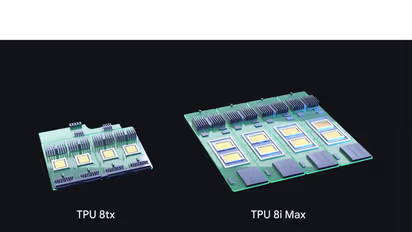
Google introduced two new tensor processing unit (TPU) systems, the TPU 8tx and TPU 8i Max, expanding its eighth-generation accelerator lineup to meet emerging enterprise requirements for artificial intelligence (AI) agents. The development marks the first instance of the company introducing four separate TPU systems within a single calendar year, according to the company’s blog post. The release follows the rollout of the 8t and 8i processors earlier this year.
The company stated that the latest additions target distinct infrastructure bottlenecks as businesses transition from human-scale computing toward autonomous agent operations. "Today, we’re taking that a step further, expanding our eighth-generation TPU portfolio with two additional systems: TPU 8i Max for massive context windows and the highest compute density per rack, and TPU 8tx for secure and confidential inference," Google said in the blog post. "This is the first time we have introduced four TPU systems in a single year," the company added.
Enterprise Use Cases and Deployment
According to Google, the TPU business now serves nearly 100 external clients, spanning trading institutions, frontier research facilities, universities, and commercial retailers. Workloads across these operations encompass model training, serving internal Gemini architectures, running agentic workflows, and deploying proprietary hardware directly inside customer data centers.
The post clarified that the announcement focuses on complete computational systems rather than raw silicon design alone. While physical chip fabrication remains bound to lengthy multi-year manufacturing schedules, system-level design combines compute, optical networking, memory, and storage configurations around modular silicon blocks to deliver specialised hardware in shorter timeframes.
The Strategy Behind TPU Modularity
"When we built our very first TPU more than a decade ago, we knew AI software would evolve much faster than silicon manufacturing ever could," Google stated. "So we made a foundational bet on system balance and modularity, architecting our TPUs as building blocks as part of our AI Hypercomputer, so engineers could rapidly adjust packaging, high-speed memory, optical networking, and security around them. That approach allows us to deliver specialized supercomputers in a matter of months rather than years," the company added.
Earlier this year, the initial eighth-generation processors established the baseline performance metrics for the series. The TPU 8t was developed as a training system delivering up to 2.7 times higher performance compared to prior generations, while the 8i handled real-time inference with an 80 per cent improvement in price-performance.
The newly added systems address higher compute density and data protection across large-scale models. Google noted that the 8i Max handles operations requiring extensive token context windows, while the 8tx provides hardware-level confidential compute for organizations bound by stringent privacy regulations.
Google also highlighted internal integration in its design workflow, pairing compiler engineers and network specialists with Google DeepMind researchers. The company uses AI systems, including AlphaChip and Gemini models, to automate and deliver physical chip layouts in hours rather than weeks, supporting ongoing accelerator development across its cloud computing infrastructure.
(Except for the headline, this story has not been edited by Asianetnews Editorial staff and is published from a syndicated feed.)
Stay updated with all the latest Business NewsShare Market NewsIPOsGold PriceDA Hike8th Pay CommissionAsianet News Official App