From generics to vaccines: How Indian pharma industry is healing the world
Synopsis
For the common people, this means more medicines at lower prices, better healthcare and jobs in factories and labs across the country.
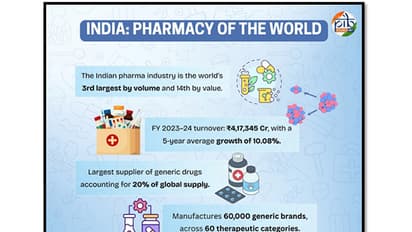
India has transformed itself into a global health leader in terms of affordability, innovation, and inclusivity over the past decade. India's pharmaceutical industry is a global giant ranking third in volume and 14th in value.
It's the largest supplier of generic medicines providing 20 per cent of the world's supply and a key player in affordable vaccines. In 2023-24, the sector's turnover hit Rs 4,17,345 crore growing steadily at over 10 per cent annually for the past five years.
For the common people, this means more medicines at lower prices, better healthcare and jobs in factories and labs across the country. From small towns to big cities, India's pharma growth is creating opportunities and saving lives.
The government claims that its schemes are the backbone of this success. The Pradhan Mantri Bhartiya Janaushadhi Pariyojana (PMBJP) runs 15,479 Jan Aushadhi Kendras, offering generic medicines at prices up to 80 per cent lower than branded ones.
A heart medicine that once cost Rs 500 might now cost Rs 100. The Production Linked Incentive (PLI) Scheme for Pharmaceuticals with Rs 15,000 crore, supports 55 projects to make high-end drugs like cancer and diabetes medicines right here in India.
Another PLI scheme with Rs 6,940 crore focuses on raw materials like Penicillin G, reducing our need for imports. The PLI for Medical Devices backed by Rs 3,420 crore is boosting production of tools like MRI machines and heart implants.
Then there's the Promotion of Bulk Drug Parks scheme with Rs 3,000 crore building mega hubs in Gujarat, Himachal Pradesh and Andhra Pradesh to make medicines cheaper and faster.
The Strengthening of Pharmaceuticals Industry (SPI) Scheme with Rs 500 crore, funds research and upgrades labs, helping Indian companies compete globally.
"These efforts mean medicines are made in India, for India and for the world keeping costs low and quality high," the government said in a statement.
India's pharma sector supplies 55-60 per cent of UNICEF's vaccines, meeting 99 per cent of WHO's DPT (Diphtheria, Whooping cough and Tetanus) vaccine demand, 52 per cent for BCG (Bacillus Calmette-Guerin is a vaccine primarily used against TB), and 45 per cent for measles. From Africa to America, Indian vaccines save millions.
At home, these schemes create jobs for young Indians, from factory workers to scientists. Foreign investors are pouring in with Rs 12,822 crore in 2023-24 alone, because they see India's potential.
India welcomes 100 per cent foreign investment in medical devices and greenfield pharma projects, making India a hotspot for global companies.
India's pharmaceutical sector is more than an industry; it's a lifeline. With schemes like PMBJP, PLI, and Bulk Drug Parks, the Modi government is ensuring no one is left behind when it comes to healthcare.
From affordable medicines at Jan Aushadhi Kendras to vaccines reaching the world, India is building a healthier, self-reliant future.
Stay updated with all the latest Business NewsShare Market NewsIPOsGold PriceDA Hike8th Pay CommissionAsianet News Official App