Elon Musk: Work will be 'optional' in less than 20 years due to AI
Synopsis
Elon Musk predicts that within 10 to 20 years, work will become optional due to advanced AI and robotics. In an interview, the Tesla CEO stated that technology will provide all goods and services, turning work into a matter of choice or a hobby.
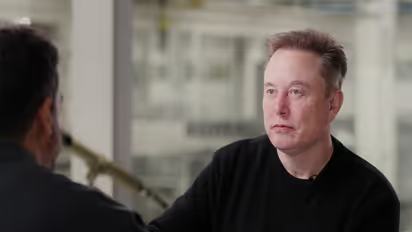
Tesla CEO Elon Musk has said that in the coming years, work may no longer be a necessity for people. Speaking during an interview with Nikhil Kamath, Co-Founder of Zerodha, Musk predicted that rapid advancements in artificial intelligence and robotics will make working "optional" in less than 20 years and possibly even sooner.
Work as a 'Hobby': Musk's Prediction
Musk stated, "My prediction is, in less than 20 years, working will be optional, working at all will be optional, like a hobby pretty much" Musk explained that with accelerating progress in AI and robotics, people may reach a stage where they can choose whether to work or not, similar to choosing whether to grow vegetables at home despite having the option to buy them from a store.
According to him, this shift could arrive in "less than 20 years, maybe even as little as 10 or 15 years," driven entirely by technology taking over almost all forms of labor. He acknowledged that some may doubt this prediction, noting that his statement may be played back after two decades to judge its accuracy. Still, he expressed confidence that the speed at which AI is improving will ultimately make work a matter of personal interest rather than economic survival.
From Shorter Workweeks to No Work At All
The discussion came after Kamath pointed out that parts of the West are already moving from six-day workweeks to five, four, and even three days. Musk responded by saying that such flexibility does not apply when building a startup or working on extremely difficult problems, where "serious hours" are still necessary. But as technology progresses further, he believes even these demanding roles will eventually be supported or replaced by advanced systems.
Kamath then asked how society might change if people were required to work only half the week, and what they might do with the rest of their time. Musk replied that the shift would go much further than shorter workweeks, people simply "won't have to work at all." He said AI and robotics would be able to provide all the goods and services people want. "If you can think of it, you can have it," he stated.
Human Competitiveness and the 'Singularity'
Kamath also raised a question about human competitiveness, suggesting that even if everyone had enough through universal high income, people might still feel the need for more because "enough is not enough." Musk admitted that this remains uncertain, since humanity is heading toward what he described as a technological "singularity," where it becomes impossible to predict what comes next.
He said that once AI reaches a point where it has fulfilled all human needs, it may begin doing things for its own purposes. Musk added that humans have natural limits, they can only eat so much, consume so much, or enjoy so much, and once those limits are reached, AI might shift its focus beyond human demands.
So Musk's remarks highlighted that with AI advancing at high speed, within the next 10 to 20 years, work could become entirely optional as technology becomes capable of providing nearly everything people need.
Stay updated with all the latest Business NewsShare Market NewsIPOsGold PriceDA Hike8th Pay CommissionAsianet News Official App